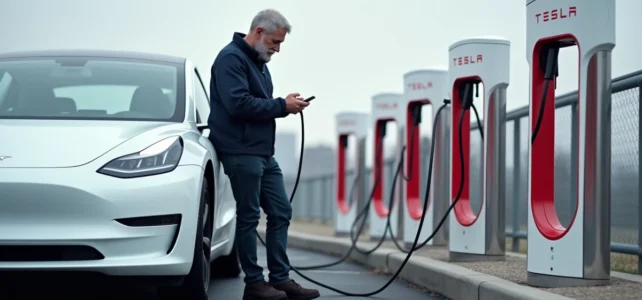
Tesla operates the largest proprietary network of fast charging stations in the world. This network, built over more than ten years, has long been reserved for the brand’s drivers. Since its gradual opening to electric vehicles from other manufacturers, the Supercharger network is evolving and raising new questions about its actual capacity, pricing, and technical limits.
Superchargers V4 at 500 kW: what the new generation of Tesla stations changes
The Superchargers V2 and V3, capping at 150 and 250 kW respectively, still make up the bulk of the installed base. The new V4 generation marks a technical breakthrough that competing guides rarely mention in detail.
Tesla has begun deploying in Europe V4 Superchargers capable of delivering up to 500 kW per charging point. Each power cabinet can provide up to 1.2 MW for eight stations, allowing power distribution based on simultaneous demand at each stall.
These cabinets are compatible with battery architectures up to 1,000 V. In practice, a vehicle equipped with an 800 V platform will be able to utilize peak power significantly higher than what V3 allows. To understand in detail the network used by Tesla, it is important to keep in mind that the actual power always depends on the architecture of the plugged-in vehicle, the battery temperature, and the station’s occupancy rate.
Field reports vary on this point: the first European V4 sites do not consistently display 500 kW peak, as some current Tesla vehicles are limited by their own power electronics. The benefit will be more visible with future models designed to utilize these power levels.
Opening to non-Tesla vehicles in France: actual status of deployment
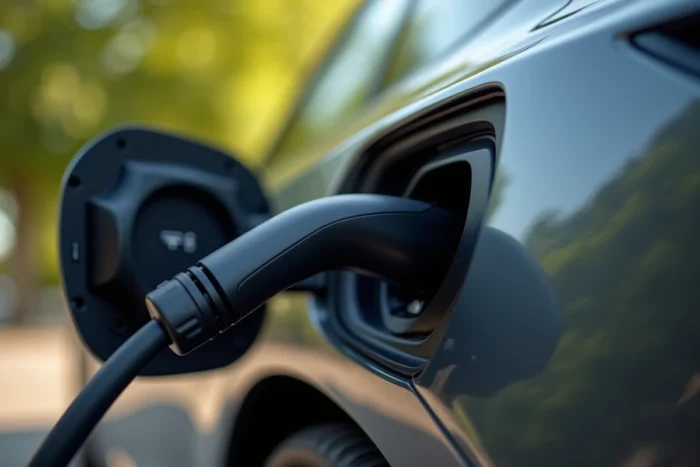
The opening of the network to drivers of other brands has been announced in successive stages. By the second quarter of 2026, Tesla reports more than 27,500 stations officially accessible to non-Tesla vehicles worldwide, out of a total network exceeding 82,000 Supercharger stations. This represents about one-third of the global network.
In France, the network includes nearly 179 Supercharger sites. Access for non-Tesla drivers is through the Tesla app or compatible roaming badges. The rates applied to non-Tesla users are generally higher than those charged to Tesla owners, with a gap that varies by site and subscription plans.
Tesla has also reported 60 million charging sessions and 2.0 TWh of energy delivered in Q2 2026, with a wait rate of less than 0.5%. This last figure is an indicator of operational maturity, but it reflects an overall average. Some heavily trafficked urban or highway stations experience peak demand, especially during school holidays.
Roaming and third-party badges: still partial compatibility
The European AFIR regulation requires operators of stations over 50 kW to accept credit card payments without a subscription. Tesla is gradually complying with this on its new installations. Meanwhile, several charging badge providers (Chargemap, Electroverse, Freshmile) provide access to some Tesla stations via roaming protocols.
The coverage by these badges is not uniform. Not all Tesla sites are yet listed on all platforms, and roaming rates often include an additional commission. Before a long trip, checking the compatibility of the badge with the planned stations remains a useful precaution.
- The Tesla app allows users to locate stations, start charging, and pay directly, including for non-Tesla users.
- Roaming badges offer partial access to the network, with variable rates depending on the mobility operator.
- Payment by credit card without an app is gradually being rolled out at newer stations, in accordance with the AFIR regulation.
Tesla Superchargers versus Ionity and competing networks in Europe
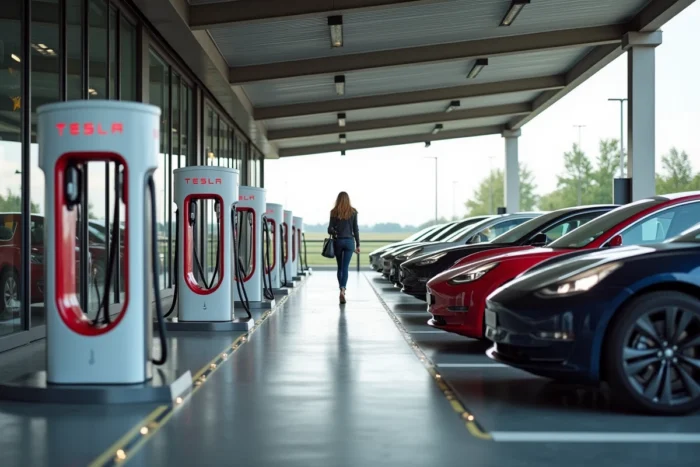
The Tesla network does not operate in isolation. Ionity, TotalEnergies, Fastned, and other operators are deploying fast stations along European highways. Comparing these networks solely on the maximum announced power would be misleading.
Tesla stands out for the density of its network and the perceived reliability of its stations. Drivers who regularly use multiple networks report higher availability rates at Tesla than at some competitors, although public data on this subject remains fragmented.
In contrast, Ionity offers power levels of up to 350 kW at its newer stations, with native CCS compatibility for all European electric vehicles. The pay-as-you-go rate at Ionity is notoriously high, but partner offers (Volkswagen, BMW, Hyundai) significantly reduce costs for affiliated drivers.
The choice between these networks depends on the vehicle, the route, and the subscription plan chosen. A Tesla driver benefits from preferential rates on their own network and native software integration (route planning, battery preconditioning). A non-Tesla driver will need to compare badge offers and verify actual coverage along their route.
Limits and gray areas of the Supercharger network in 2026
Despite its size and reputation, the Tesla network has concrete limitations that official presentations do not highlight.
- The maximum announced power (250 kW in V3, 500 kW in V4) is only reached under optimal conditions: preheated battery, low charge level, lightly used station. In practice, the average power received by the vehicle is often well below the displayed peak.
- Power sharing between adjacent stations, inherited from V2 and partially corrected in V3 and V4, can reduce charging speed when the station is full.
- Rates per kWh vary from one station to another and change without notice. Tesla has adjusted its prices several times in recent years, sometimes upward.
The integration of Superchargers into Google Maps, with a recently tested availability forecasting feature, could improve trip planning. The available data does not yet allow for measuring the actual impact of this feature on user experience.
The Supercharger network remains a major asset for Tesla drivers and an increasingly viable complement for others. Its scaling up with V4, combined with the opening to non-Tesla users, is reshaping the balance of power among charging operators in Europe. The open question now concerns the actual pace of V4 deployment and Tesla’s ability to maintain its service quality as the number of users increases.