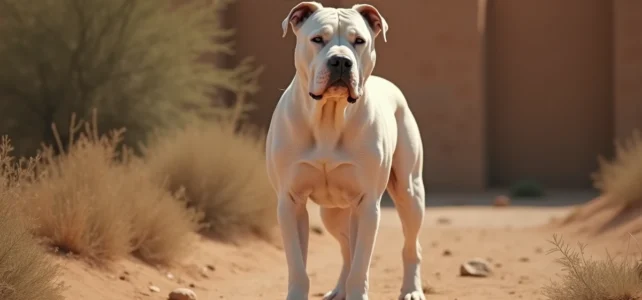
The Bully Kutta is a molossoid whose morphology and temperament require a technical understanding before any acquisition process. This breed is not recognized by the FCI and is absent from the LOF registers; it circulates in informal breeding networks where selection relies more on the reputation of bloodlines than on a unified official standard.
Morphotype of the Bully Kutta: bone structure and skin folds
The Bully Kutta stands out from other Asian mastiffs due to a precise combination: heavy bone structure, thick skin, and heavily wrinkled skin around the neck. The very name of the breed confirms this peculiarity, as “bully” derives from the Punjabi word bohli, meaning “very wrinkled,” and kutta simply means “dog.” There is no etymological link to the Anglo-Saxon notion of “bully” or to the American Bully.
For adult males, the height at the withers ranges from 76 to 86 cm with a weight of 70 to 90 kg. Females reach 75 to 80 cm and weigh 60 to 70 kg. These sizes place the Bully Kutta among the most massive breeds in the world.
The head is proportionate to the body, without excessive facial wrinkles (unlike the Dogue de Bordeaux or the Shar-Pei). The ears, naturally drooping and small, are still frequently cropped in the countries of origin, a practice we strongly discourage. The coat is short, which makes maintenance easier but offers limited protection against the cold.
To delve deeper into the historical lineage of this breed with the molossers of South Asia, the origins of the bully kutta on Blog Animaux traces documented crossings since the time of British colonialism.

Historical crossings and genetic drift of the Bully Kutta
The genetic foundation of the Bully Kutta results from several centuries of empirical selection in Pakistan and northern India. Local mastiff-type dogs were crossed in the 19th century with bull terriers and greyhounds imported by British colonists. This period of crossings enhanced muscular explosiveness while refining the silhouette.
The current issue is the fragmentation of bloodlines. Without a centralized pedigree book, each breeder works according to their own criteria. We observe at least three distinct morphotypes circulating under the same name:
- The “Nagi” type from Sindh, drier and faster, with an elongated muzzle reminiscent of greyhound influence
- The “Aseel” type from Punjab, heavier and more compact, favored for guarding agricultural properties
- The “modern” type, often resulting from undocumented crossings with other molossoids, whose conformity to the historical breed is questionable
This lack of an official registry makes reliable identification of a Bully Kutta particularly complex for a European buyer.
Transition of use: from fighting dog to farm guardian
The Bully Kutta has long been associated with dog fighting, an illegal practice still documented in some regions of the Indian subcontinent. The recent trend shows a repositioning towards property guarding and security.
Recent reports in India and Pakistan confirm this transition. Pakistani breeders are increasingly directing selection towards stable individuals capable of deterring without uncontrolled aggression. In India, recent regulations (referred to as “2026 ban laws”) aim to regulate or prohibit the ownership of certain molossoid breeds, including the Bully Kutta.
This unstable regulatory context in the countries of origin complicates the export of quality individuals. In Europe, since the breed is not recognized, it does not fall under the specific legislation for categorized dogs in France. However, this does not exempt the owner from adhering to general obligations related to large dogs.
Breeding the Bully Kutta: health requirements and selection of breeders
A poorly selected Bully Kutta accumulates dysplasia, behavioral instability, and reduced life expectancy. Reported life expectancy varies significantly according to sources, from 5 to 12 years, which directly reflects the disparity in breeding conditions.
We recommend systematically checking the following points before any acquisition:
- X-rays of the hips and elbows of both parents (hip dysplasia is endemic among molossoids of this size)
- Temperament of the parents observed in real situations, not just on promotional videos
- Absence of inbreeding over at least three generations, documented by the breeder
- Early socialization of puppies with varied humans, other dogs, and environmental stimuli before eight weeks
The growth of a Bully Kutta puppy is long and nutritionally demanding. An inadequate diet during the first eighteen months leads to irreversible joint deformities. Veterinary follow-up should be monthly during the first year.
Managing dominant behavior
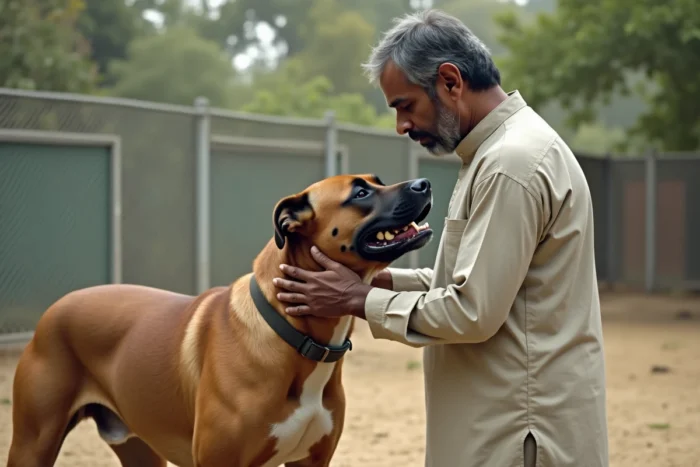
The temperament of the Bully Kutta is described as loyal, protective, and dominant. In practice, this means that this dog systematically tests the limits of its owner during adolescence (between six and eighteen months). Firm, consistent, and non-coercive training should be established as soon as the puppy arrives.
A Bully Kutta that has not been properly socialized can become potentially dangerous given its mass. This is not a dog for first-time owners, and the presence of young children in the household imposes additional precautions that many sellers downplay.
The need for daily exercise is significant: one to two hours of physical activity per day, ideally in a secure, enclosed space. An apartment is incompatible with this breed, regardless of size. A fenced area of at least several hundred square meters is the minimum functional requirement.
The Bully Kutta remains a niche breed in Europe, difficult to acquire under good conditions and demanding to maintain. The absence of an official standard, the fragmentation of bloodlines, and the controversial past of the breed impose a rigorous approach on any potential buyer. It is better to forgo acquiring a 90 kg molosser than to place it in an unsuitable environment.