
On a pool shell construction site, the concrete belt is often poured at the end of the process, when the backfill is done and the coping stones are waiting on pallets. It is treated as a formality. Yet, it is this peripheral belt that locks the shell into the ground and supports all the finishes. If poorly sized, it generates cracks, shifting coping stones, and even structural issues that insurance may classify as a ten-year disaster.
Concrete belt for pool shell: what the ground imposes before sizing
Before discussing width or thickness, we look at the terrain. A clayey soil that swells and shrinks over the seasons does not behave like well-compacted sandy backfill. On clayey terrain, differential movements can cause progressive cracking of the concrete belt and peripheral slabs, with issues that then propagate to the shell itself.
In practical terms, this means that we do not choose the dimensions of the concrete belt for the pool shell from a generic chart. We adapt them to the soil ratio, when it exists, or at a minimum to the observation of the terrain during excavation.
A stable and draining soil allows for a more modest section. An unstable, waterlogged, or heterogeneous soil requires a wider, thicker belt, with reinforced rebar at the corners. Feedback varies on this point, but the trend is clear: it is better to slightly oversize than to have to redo a cracked belt after the first winter.
Width and thickness of the concrete belt: reliable benchmarks
The peripheral belt of a pool shell does not have a dedicated NF standard that would set its dimensions to the nearest centimeter. We work with practices accepted by pool builders and control offices.
Width of the concrete belt
The common width is in a range that exceeds the simple lip of the shell. It must allow for the installation of coping stones and provide a sufficient base to support the loads at the pool’s edge. For a standard pool (type 8×4), we aim for a width that covers at least the overhang of the coping plus a margin for formwork.
- On load-bearing and stable soil, a moderate width is sufficient if the backfill is properly compacted in successive layers.
- On clayey soil or recent backfill, we widen the belt to distribute the loads over a larger surface and limit the risk of punching.
- In the presence of an adjacent concrete or tiled beach, the belt can be integrated into the peripheral slab, which modifies the formwork but not the structural principle.
Thickness of the concrete belt
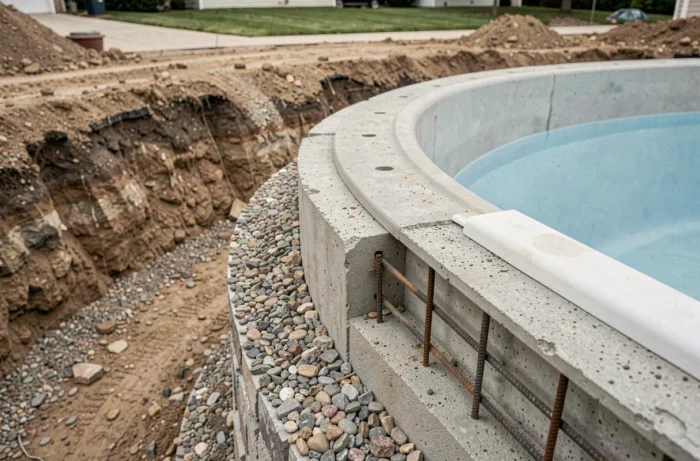
The thickness determines the rigidity of the whole. A belt that is too thin breaks instead of bending, especially at the corners and changes in direction of the shell. We seek a thickness that allows for proper coverage of the rebar with sufficient coverage at the bottom and top.
The rebar plays a direct role here. Rebar that is too close to the surface rusts, swells, and causes the concrete to spall. Therefore, thickness is not a luxury: it is the condition for the reinforcement to remain protected over time.
Reinforcement and formwork: costly on-site mistakes
We regularly see belts poured with a simple welded mesh laid flat, without continuity at the corners. This is insufficient. The belt works in bending and twisting, especially when the pool is empty and the soil pressure pushes the shell inward.
The reinforcement must form a continuous loop around the pool, with correct overlaps at the junctions of bars and reinforcements at the corners. Right angles or tight curves concentrate stresses. Without stirrups or return of rebar, this is where the first crack appears.

Formwork deserves equal attention. Poorly aligned formwork produces a belt whose top is not level. The result: the coping stones are installed with variable thicknesses of adhesive, they sound hollow in places, and they come off after two seasons. We check the level with a rotating laser or a mason’s rule around the entire perimeter before pouring.
Sensitive points around sealed fittings
Skimmers, return jets, vacuum ports: each sealed fitting creates an interruption in the reinforcement and in the formwork. Each reservation must be anticipated before pouring, with local reinforcements around the opening. Pouring first and drilling later weakens the section and creates microcracks that evolve with freezing.
Ten-year guarantee and concrete belt: a direct link often overlooked
A poorly executed concrete belt is not just an aesthetic issue. It can be reclassified as the origin of a ten-year disorder if it causes through cracks, a loss of watertightness in the pool, or deformation of the shell. The distinction between aesthetic microcracks and structural cracks determines insurance coverage.
In practice, an undersized, poorly reinforced, or non-integrated belt can lead to partial or total denial of coverage if it does not comply with accepted practices for an underground structure. For the individual having their pool installed, this means that the sizing of the belt is not a topic to be overlooked at the time of the quote.
- Ask the pool builder for the details of the reinforcement and the section planned for the belt.
- Check that the quote explicitly mentions the reinforced concrete belt as a separate item, with its characteristics.
- Keep photos of the reinforcement before pouring, as they serve as proof in case of later disputes.
The sizing of a concrete belt for a pool shell is not limited to a standard width and thickness. It is a trade-off between the nature of the soil, the type of coping, the shape of the pool, and the quality of the backfill. A continuous reinforcement, level formwork, and correct coverage of the rebar remain the three non-negotiable points, regardless of the terrain.