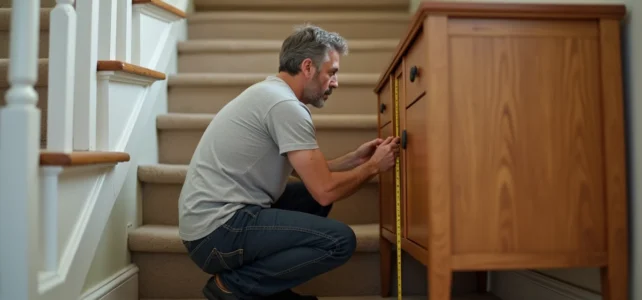
An angled sofa stuck at the first turn, a sideboard scraping the railing along its entire length, a wardrobe wedged halfway up the stairs with no possibility of backing up: we have all seen or experienced this scene. The problem almost never comes from the weight of the furniture, but from a lack of anticipation regarding the actual dimensions of the passage. Before lifting anything, you must measure, compare, and sometimes accept that the furniture will not fit as it is.
Measure the diagonal of the furniture, not just its width
Most people only note the width and height of the furniture, then compare them to the width of the staircase. This approach overlooks a crucial parameter: when tilting a piece of furniture to navigate a turn or a low ceiling, it is the diagonal that determines whether the passage is clear.
Let’s take a concrete example. You are moving a two-door wardrobe to an upper floor. Standing upright, it is too tall for the ceiling of the stairwell. You tilt it. At this moment, it is no longer the height or width that matters, but the diagonal of the widest face (the one visible from the front, with the door closed). If this diagonal exceeds the ceiling height at the lowest point of the staircase, the furniture remains stuck.
To calculate it without a complicated formula, measure the height and width of the furniture, then stretch a tape measure from one lower corner to the opposite upper corner. This figure is what needs to be compared at each narrow passage. You can also check if a piece of furniture fits in the staircase by applying this diagonal logic to the different segments of the stairwell.

Measure the staircase at the right points
A staircase does not have a single dimension. It has several, and they vary from landing to landing. People often measure the width between the walls, which is a good start, but it is far from sufficient.
Measurement points not to forget
- Usable width between the railing and the wall: the railing easily takes up several centimeters. On an old staircase, the wooden or wrought iron handrail can significantly reduce the passage.
- Height under the ceiling at the lowest point, often located under the upper flight, where the ceiling slopes down. This is the classic trap: the furniture fits in width but hits the underside of the upper staircase.
- Depth and width of the turning landing: on a U-shaped or L-shaped staircase, this is where the furniture must pivot. If the landing is too short, a long piece of furniture will not be able to turn even if it fits in the straight flights.
- Angle of the turn: a quarter turn (90°) allows for more margin than a half turn (180°). A spiral staircase, on the other hand, requires continuous rotation with an often very tight inner radius.
Each measurement is noted on a quick sketch, floor by floor. The narrowest passage along the entire route sets the limit.
Spiral staircase: the most constraining case
On a spiral staircase, the usable width significantly decreases on the central core side. In practical terms, only the furniture whose smallest face fits into the inner radius has a chance of going up. For a rectangular piece of furniture, it is presented upright, with its narrowest face oriented towards the center. If this face exceeds the available radius, the furniture must be disassembled or you must give up on the staircase.
Simulate the passage before lifting
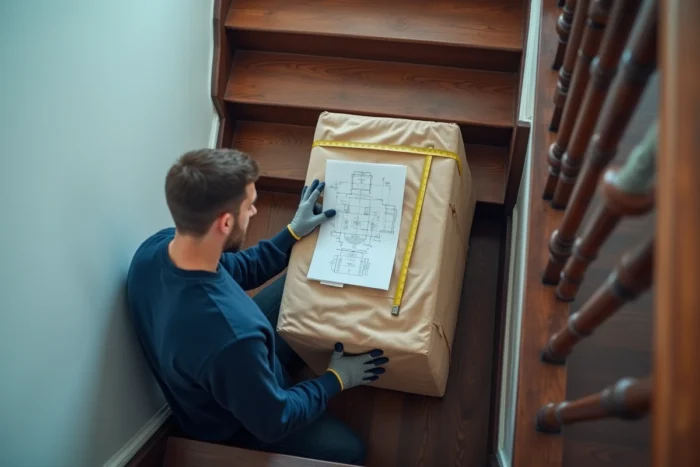
Measurements on paper provide a good indication, but they cannot replace a real-life test. You can simulate the bulk of the furniture with cardboard cut to the right dimensions (or simply with wooden battens assembled to the correct length). You then make the complete journey, from the bottom of the staircase to the destination room.
This method reveals invisible blockages on a plan: a wall sconce that protrudes, a radiator fixed in the turn, an electrical meter protruding on the landing. The cardboard template takes ten minutes, a stuck piece of furniture costs hours.
If the template passes with less than two centimeters of margin on each side, you are entering a risk zone. The actual furniture is rigid, heavy, and harder to control than a rectangle of cardboard. With so little play, the slightest angle deviation can cause a blockage or a scratch on the wall.
Dismantle, pivot, or give up on the staircase
When the measurements show that the passage is too tight, three options arise.
Dismantling the furniture is the most straightforward solution. You remove the legs, removable shelves, and hinged doors. A sideboard without its doors often loses several centimeters in depth, which can be enough. Some corner sofas separate into two independent modules, each much easier to maneuver than a single block.
Pivoting the furniture around a different axis also works. A dresser that blocks horizontally can fit vertically or tilted at 45 degrees. This brings us back to the question of the diagonal: each orientation of the furniture presents a different footprint, and testing several tilt angles can sometimes change everything.
When no configuration works, an external lift remains the fallback solution. Professional movers systematically take into account the configuration of the staircases (width, turns, number of floors without an elevator) in their quotes, and difficult access via the staircase can increase the price much more than the volume of the furniture itself.
Insurance and preparation of the furniture before passage
A point often overlooked: moving insurance contracts can reduce or deny compensation if the furniture has not been properly prepared. Unemptied drawers, undismantled parts, lack of protection, are all reasons cited by insurers to limit coverage in case of damage in the staircase.
Before attempting the passage, systematically empty the drawers and shelves, protect the corners with blankets or foam film, and secure the swinging doors with tape to prevent them from opening during the maneuver. This preparation also reduces weight, making angle adjustments easier in a tight turn.
The most reliable approach remains to combine measurement, simulation, and preparation. A well-measured piece of furniture, tested with a template, and properly protected will fit through most straight or quarter-turn staircases. For more complex configurations (spiral, very short landings, low ceilings), it is better to invest in a lift than to force a passage that will damage the furniture, the walls, and sometimes the insurance coverage.