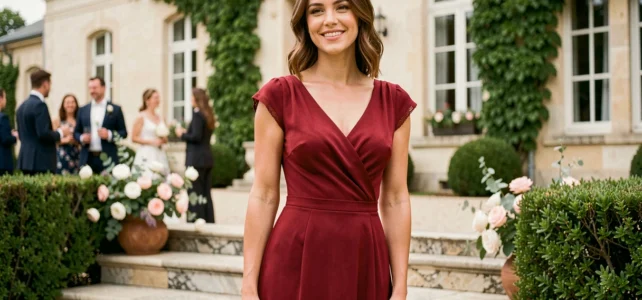
Red remains one of the few colors that still polarizes in the guest’s wardrobe. The question is no longer about permission or prohibition, but about calibration: shade, cut, cultural context, and balance of accessories determine whether the outfit works or goes awry.
Color temperature and undertone: the real criterion for selecting a red dress for a wedding
We regularly observe the same mistake: choosing a red based on personal taste without considering the lighting context of the ceremony. A saturated vermilion red, perfect in artificial light, becomes aggressive in the full July sun. The reading grid is based on the color temperature of red and its saturation.
Reds with blue undertones (cherry, raspberry, burgundy) absorb light and create less contrast with the environment. They work better in dark places of worship or indoor receptions. Reds with yellow undertones (vermilion, poppy, tomato) project more and catch the eye, making them suitable for outdoor ceremonies as long as they are balanced by a simple cut.
The decision to wear a red dress to a wedding relies as much on this chromatic analysis as on the announced dress code. A deep burgundy in matte crepe does not produce the same effect as a bright red in duchess satin, even if both are technically “reds”.
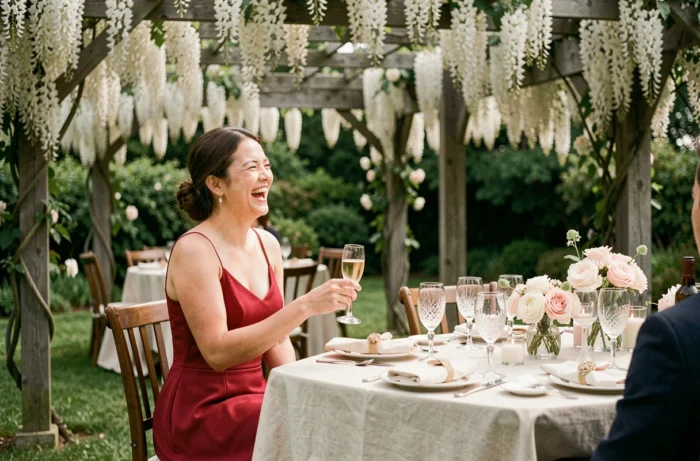
Red dress and religious context: real constraints to anticipate
Dress etiquette varies significantly depending on the place of worship and local tradition. Some conservative Catholic parishes still consider red to be too showy for a religious ceremony. In weddings influenced by South Asian culture, red is, on the contrary, the traditional color of the bride, and wearing it as a guest can create a role confusion.
Checking the expectations of the couple remains the only reliable rule. General etiquette guides do not cover local specifics. A simple message to the future spouses or their witness clears up any ambiguity in seconds.
For civil ceremonies and secular receptions, the religious constraint disappears. Red is treated like any strong color: acceptable as long as the cut does not compete with the bride’s outfit.
Styles that work in bright red without stealing the spotlight from the couple
Red amplifies everything. A high slit, a plunging neckline, or a backless design that would go unnoticed in navy blue becomes spectacular in red. The simplicity of the cut compensates for the intensity of the color.
- The straight or slightly flared midi dress, with three-quarter sleeves or wide straps, remains the safest format for a daytime wedding. It limits skin exposure and refocuses attention on the fabric and color.
- The flowing long dress with a boat neckline or high collar is suitable for evening ceremonies. The draping creates movement without visual overload.
- The short model above the knee, in crepe or structured cotton, works for casual countryside weddings, provided shiny finishes are avoided.
We recommend avoiding layering textures (lace over satin, sequins over tulle) which, when combined with red, create a theatrical costume effect. One material, one message.
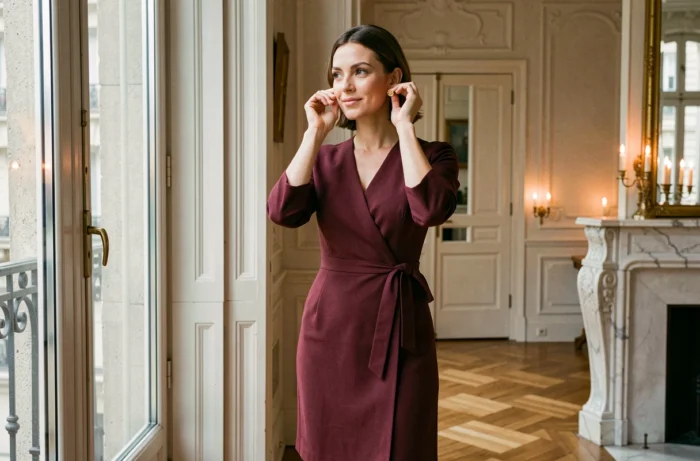
Accessories and shoes to balance a red ceremony outfit
The classic mistake is to accessorize a red dress like a neutral dress. Red imposes a limited vocabulary of accessories to avoid chromatic overkill.
Neutral or metallic shoes
Nude, matte black, and gold remain reliable choices. Nude elongates the silhouette without cutting the line of the dress. Gold adds warmth without competing with red. We advise against matching red shoes: the total monochrome effect works in editorial contexts but weighs down the outfit in real-life settings.
Discreet jewelry, no accumulation
Letting the dress be the focal point means reducing jewelry to one or two pieces. Fine dangling earrings are sufficient. A statement necklace competes with the neckline and fragments the gaze.
- Yellow gold pairs well with warm reds (vermilion, tomato).
- White gold or silver suits cool reds (cherry, burgundy, raspberry).
- Pearls add a softness that tempers the energy of red, particularly in religious ceremonies.
Ceremony bag
A simple clutch in smooth leather or structured fabric, in a neutral tone (black, beige, ivory), completes the outfit without overwhelming it. Red handbags create a total look effect that is rarely mastered outside of the runway.
Makeup and hairstyle: do not double the impact of red
The trap of matching red lipstick to the red dress is documented in most specialized guides. The whole look appears too coordinated and loses its naturalness. A rosy nude or warm brown on the lips, paired with a slightly defined eye (mascara, fine liner), creates a more sophisticated balance.
For the hairstyle, pulling the hair up clears the neckline and allows the color of the dress to occupy the visual space. A low bun or a sleek ponytail works better than a voluminous hairstyle that competes with the fabric’s shine.
Red at a wedding ceremony is not a faux pas when the calibration is rigorous. The right shade for the lighting context, a cut that does not overshadow, understated accessories, and makeup that does not compete with the dress are enough to transform a color known for its risks into a choice of bold elegance.