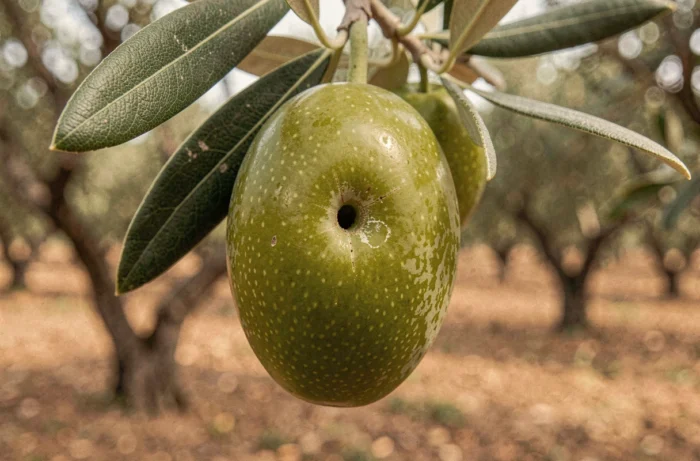
The olive fly (Bactrocera oleae) lays its eggs in the drupe as soon as the pit begins to harden. The larva then develops in the pulp, causing premature fruit drop and a marked deterioration in oil quality. Treating at the wrong time amounts to wasting product without reducing the infestation. The choice of the intervention window relies on the insect’s biological cycle, active monitoring of populations, and local climatic conditions.
Biological cycle of Bactrocera oleae and vulnerability periods
The olive fly completes three to five generations per year depending on the climate. The overwintering adults emerge in April, but a so-called “white” period follows, during which the flies abandon the olive groves. They return around mid-June, when the drupes reach a development stage compatible with egg-laying.
Egg-laying truly begins with the hardening of the pit. This phase opens the first treatment window. Early trapping, starting in June, allows for the detection of adult activity resuming before females begin to puncture the fruits.
Understanding this cycle helps target interventions rather than following a fixed schedule. An olive grove located in a warm coastal area will not exhibit the same activity peaks as a high-altitude orchard, where nighttime temperatures delay larval development. The detailed information available on the Une Fleur Un Jardin website usefully complements this approach with a reading grid adapted for amateur gardeners.
Temperature thresholds and trapping: triggering treatment at the right signal
The olive fly becomes active in a temperature range between 20 and 28 degrees. Below this, its metabolism slows down. Above about 30 degrees, the mortality of eggs and larvae increases, which naturally slows the infestation during summer heat peaks.
Treatment is not decided on a fixed date but based on measurable signals. Two complementary tools guide the decision:
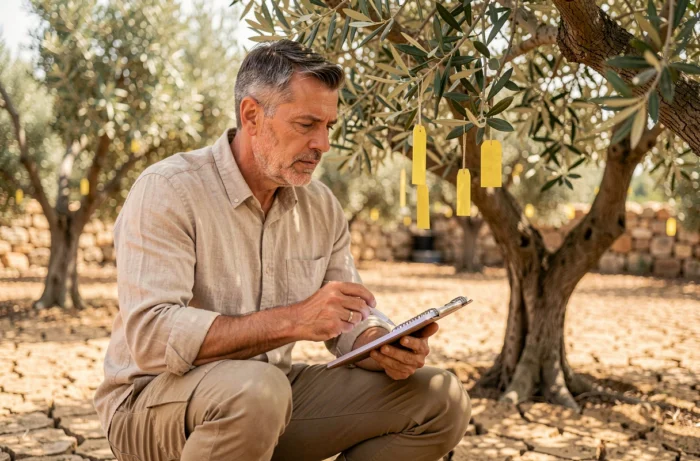
- Yellow sticky traps or McPhail traps, checked weekly from June, quantify adult pressure. A threshold of regular captures indicates the start of the fertile generation.
- Sampling of drupes by puncture of laying, conducted on a representative batch of fruits collected at waist height, reveals the actual infestation rate. It is this rate, and not just the counting of adults, that triggers curative treatment.
- The plant health bulletins (BSV), published region by region as part of the national monitoring network, provide localized alerts and updated risk maps. They advantageously replace the generic calendar reference.
This triptych (adult trapping, drupe sampling, BSV) forms the basis of a reasoned protection against the olive fly. Treating without this data amounts to intervening blindly.
Calcined white clay: a preventive barrier to be applied early
Calcined kaolinite acts as a physical barrier on the surface of the fruit. Applied in a thin film, it alters the color and blocks the volatile compounds that the female uses to identify the olive. The disoriented fly gives up laying eggs.
The effectiveness of this white clay can achieve a damage reduction of around 70 to 80%, even in years of high pressure. The determining factor remains the application schedule: the first spraying must occur before the first punctures, so before trapping signals significant female activity.
The persistence of the product depends on weather conditions. Rain exceeding a few millimeters partially washes away the deposit. It is then necessary to renew the application to maintain coverage. Treatments continue until harvest if pressure persists.
Application conditions for suitable coverage
The mixture is prepared in a sprayer set to produce fine droplets, covering the entire foliage. Treating early in the morning or late in the day limits evaporation and improves adherence to the drupe. The wind must remain low to avoid drift, especially since regulations impose safety distances from homes.
Regulations and spraying distances near homes
The decrees of 2022 and 2023 complementing the decree of May 4, 2017 strictly regulate the spraying of phytosanitary products near inhabited areas. In arboriculture, of which the olive tree is a part, a minimum distance of 10 meters applies for most products. This distance increases to 20 meters for substances classified as concerning (CMR1 or endocrine disruptors).
These constraints concretely change the timing of treatment. An olive grower whose trees border a residence may sometimes have to adjust the timing of intervention or prioritize biocontrol solutions (clay, Spinosad as bait) exempt from the most restrictive distances.
Spinosad, allowed in organic farming, remains a useful supplement in cases of late high pressure, but its pre-harvest interval is seven days. Its use should remain limited due to its negative effects on beneficial insects.
Early harvest: the last lever against late infestation
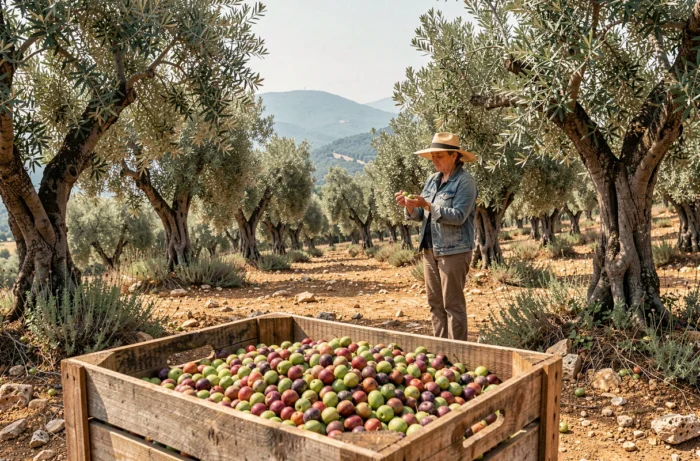
When the pressure from the fly remains high at the end of the season despite treatments, advancing the harvest date mechanically reduces the exposure time of the fruits. Olives harvested before full maturity yield a greener, more bitter oil, with a slightly lower oil yield, but the sanitary quality of the batch is preserved.
This choice is reasoned on a case-by-case basis: monitoring punctures on drupes in October guides the decision. A rapidly progressing infestation justifies an early harvest of two to three weeks.
Managing the olive fly relies less on a universal calendar than on careful reading of the biological and climatic signals specific to each plot. Regular trapping, fruit sampling, and consultation of regional BSVs remain the three pillars of effective intervention, regardless of the chosen control method.