
La Petite Pierre is perched on a rocky spur, at the northern edge of the Vosges. This Alsatian village serves as the gateway to the Parc naturel régional des Vosges du Nord, a territory classified as a World Biosphere Reserve by UNESCO. Rather than listing dozens of sites, let’s focus on what truly deserves your time both on-site and in the surrounding area.
Trail of Tales and Legends: A Game-Changing Hike
Have you ever walked a marked hiking trail without remembering much of the journey? In La Petite Pierre, a trail around Alsatian tales and legends winds through the medieval village and its forested outskirts. The principle: at each stop, a sign tells a local legend related to the sandstone, the ruins, or the surrounding forest.
This format appeals to families because it provides a narrative thread to the walk. Children move forward to discover the next part of the story, not just to reach a viewpoint. The route passes through typical undergrowth of the Vosges du Nord, where sandstone blocks emerge between the roots of beech trees.
To explore all of the activities offered by La Petite Pierre, the trail of tales is a good starting point before tackling longer routes like that of the three rocks.
Medieval Heritage in La Petite Pierre: Castle, Simultaneous Church, and House of Pagans
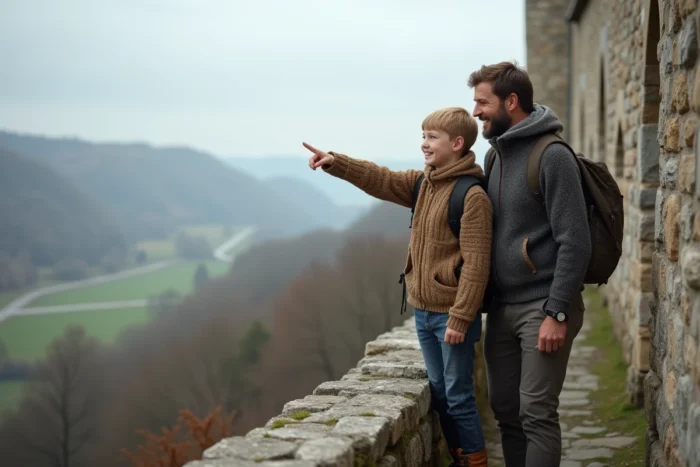
The castle of Lützelstein overlooks the village from its pink sandstone promontory. It now houses the Maison du Parc naturel régional, making it a hybrid location: you can visit medieval ramparts and exhibitions on local biodiversity. Take the time to climb the curtain walls; the view over the canopy of the Vosges du Nord is worth the detour.
Just a few steps away, the simultaneous church of Notre-Dame preserves 15th-century frescoes visible in the nave. The term “simultaneous” means that Catholics and Protestants shared the same building for centuries, a rare Alsatian peculiarity.
The House of Pagans, an Overlooked Belvedere
This atypical building, nestled at the edge of the spur, offers an unobstructed view of the forest. The building itself intrigues with its ancient architecture, difficult to date precisely. It’s a short stop (about twenty minutes is sufficient) but complements the visit to the castle well.
Nature Outings in the Vosges du Nord: What to Know Before You Go
The Parc naturel régional des Vosges du Nord covers a vast forested area, dotted with sandstone rocks shaped by erosion. From La Petite Pierre, several hiking loops start directly from the village, with no need for a car.
Before planning an outing between spring and the end of summer, keep in mind a concrete regulatory constraint. The Park reminds that between March 15 and September 30, campfires, bivouacking, and smoking are prohibited in the forest. Burning vegetation is also prohibited. These restrictions change the way you organize a picnic or a night outdoors.
- Prefer designated areas with tables and trash bins, which are numerous along the trails marked by the Club Vosgien
- Take your waste with you if you venture off the main trails, as there are no bins available in the undergrowth
- Check the weather before you go: sandstone trails become slippery after rain, especially on sloped slabs
Activities Nearby: Saverne, the Lalique Museum, and Sandstone Castles
La Petite Pierre is not visited in isolation. The surroundings concentrate several sites that justify a stay of two or three days rather than a day trip.
Saverne and Its Castles
About twenty minutes by car, Saverne features a medieval enclosure, a cloister, and the Rohan Castle. The town often serves as a base for exploring the northern Vosges. Above Saverne, the Haut-Barr Castle (nicknamed “the eye of Alsace”) offers a panorama of the Rhine plain on clear days.
Lalique Museum in Wingen-sur-Moder
About fifteen minutes from La Petite Pierre, Wingen-sur-Moder is home to the Lalique Museum. The place traces the history of glassmaking and art glass, with pieces by René Lalique displayed in a contemporary building. It’s a great outing for rainy days, which are common in the Vosges du Nord in spring and autumn.
Immersive Experiences and Participatory Outings: The New Local Offer
The Hanau-La Petite Pierre tourist office now offers a guide to experiences focused on participatory activities. The idea goes beyond the classic guided tour: these are outings designed with local actors (artisans, naturalists, producers) where visitors get hands-on experience.
This shift towards immersive formats reflects a trend observed in other regional natural parks in France. For visitors, this means it’s better to check the current program before coming rather than just relying on permanent heritage sites.
- Guided nature outings allow you to observe forest wildlife with a naturalist guide
- Workshops related to local artisanal heritage (glassmaking, pottery) are organized occasionally
- Short formats, designed for families, generally last between one and two hours
La Petite Pierre draws its appeal from a balance between medieval heritage, preserved nature, and nearby cultural offerings. The territory can be explored on foot from the village for the trails, or by car for Saverne or the Lalique Museum. Two to three days allow you to enjoy it without rushing, especially if you include one or two participatory experiences in your itinerary.