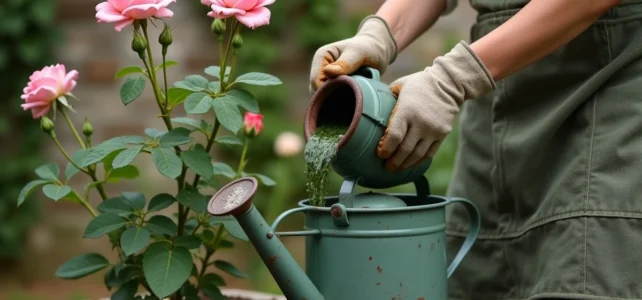
Nettle manure applied to rose bushes does not produce the same results depending on the type of rootstock, the timing of application, and the method of dilution. A rose grafted onto Rosa canina does not react like a own-rooted rose, and the application window is as important as the dosage itself. Comparing these variables helps determine when nettle manure truly benefits flowering and when it compromises it.
Nettle manure on grafted and own-rooted roses: compared reactions
The distinction between a rose grafted onto vigorous rootstock and an own-rooted rose shapes the entire nitrogen application strategy. Rootstocks like Rosa laxa or Rosa canina naturally enhance vegetative vigor. A repeated application of nettle manure on these roses causes a surge of shoots and foliage at the expense of flowering.
| Type of rose | Reaction to repeated nettle manure | Recommended number of applications | Recommended supplement |
|---|---|---|---|
| Grafted onto vigorous rootstock (Rosa canina, Rosa laxa) | Strong vegetative growth, reduced flowering | 1 to 2 applications at the beginning of the season | Comfrey manure (potassium) to support flowering |
| Own-rooted or grafted onto less vigorous rootstock | Balanced stimulation of foliage and flowers | 2 to 3 applications between March and June | Comfrey manure in alternation starting in May |
| Miniature or potted rose | Risk of root burn if overdosed | 1 diluted application at the beginning of the growing season | Abundant watering after application |
This table highlights a point that most guides on nettle manure do not address: for vigorous grafted roses, limit nettle manure to a maximum of two applications. Beyond that, the bioavailable nitrogen promotes wood growth at the expense of flower buds.
Knowing how to apply nettle manure to roses first requires identifying the rootstock. On the labels of roses sold in garden centers, this information is usually found at the bottom of the variety sheet.

Dilution of nettle manure for roses: watering at the base vs. foliar spraying
The two application methods target different functions. Watering at the base nourishes the root system with nitrogen and minerals. Foliar spraying stimulates the plant’s natural defenses against aphids and certain fungal diseases.
Watering at the base of rose bushes
The standard dilution for root watering is around one volume of manure to ten volumes of water. On a rose in the ground, this concentration is sufficient to provide the necessary nitrogen for the start of growth without saturating the soil.
Always water on moist soil, never on dry ground. Dry soil concentrates the manure at the level of the superficial roots and can cause burns. Plan a classic watering with clear water the day before, then apply the diluted nettle manure the following morning.
Foliar spraying as an aphid repellent
For a foliar spray, the dilution should be significantly weaker: about one volume of manure to twenty volumes of water. The goal is not to nourish but to deposit an aromatic and slightly irritating film for aphids.
- Spray early in the morning or late in the day, never in full sun, to avoid leaf burns from the magnifying effect
- Target the underside of the leaves, where aphids cluster, rather than the upper surface
- Do not spray on open flower buds: nettle manure stains petals and leaves a persistent odor on cut flowers
- Space sprays at least ten days apart to avoid saturating the foliage with nitrogen
Nettle manure and Bordeaux mixture on roses: risk of copper overdose
Many gardeners alternate nettle manure and Bordeaux mixture on their roses, particularly against black spot (marssonina) and powdery mildew. This combination poses a rarely mentioned problem: the copper-nitrogen accumulation can disrupt the soil in the medium term.
The copper from the Bordeaux mixture accumulates in the top few centimeters of soil. Combined with regular nitrogen applications through nettle manure, it alters the microbial activity of the surface layer. Microorganisms that decompose organic matter do not tolerate excess copper well, which slows down the natural mineralization of the soil.
The precaution is to never apply these two preparations in the same week. A gap of at least seven days between a Bordeaux mixture treatment and a nettle manure watering allows the soil time to absorb each application separately. On roses regularly treated with Bordeaux mixture, reducing nettle manure to a single spring application is enough to stimulate recovery without increasing the copper load.
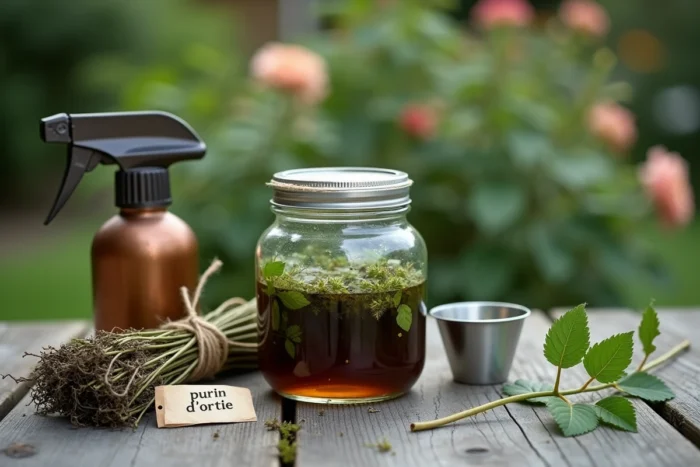
Application schedule for nettle manure on roses according to the season
The timing of the application is as important as the dose. Nettle manure applied in July on a remontant rose produces the opposite of the desired effect: it stimulates leaf production when the plant should focus its energy on the second wave of flowering.
- March-April (bud break): first application at the base, classic dilution. The rose comes out of dormancy and absorbs nitrogen to build its leaf structure
- May (pre-flowering): diluted foliar spray as an aphid repellent. No nitrogen watering at the base if the rose is grafted onto vigorous rootstock
- June-July: complete stop of nettle manure on remontant roses. Switch to comfrey manure, richer in potassium, to support the formation of flower buds
- September: a last very diluted foliar application can accompany the autumn resurgence, only if the rose shows signs of vegetative weakness (pale foliage, slowed growth)
After July, comfrey manure replaces nettle manure on remontant roses. The potassium from comfrey promotes flowering where the nitrogen from nettle would favor wood growth.
Nettle manure remains a remarkable natural fertilizer for roses, provided the number of applications is adapted to the rootstock and the vegetative calendar is respected. A well-nourished rose at the beginning of the season, then supported with potassium from pre-flowering, will produce more flowers than a rose watered with nettle all year round.