
The development of a baby is not measured solely by their weight curve or the age of their first steps. Several factors, from early physical contact to sleep quality and the introduction of foods, have a lasting impact on their health and cognitive abilities. Comparing these factors allows for better targeting of the actions that truly matter during the first year.
Key factors for baby well-being: comparative table of their impact
Not all parental actions have the same weight on infant development. The table below compares four levers often cited by health professionals, specifying their optimal window of action and their documented effect.
| Factor | Optimal Window | Main Documented Effect | Implementation Condition |
|---|---|---|---|
| Skin-to-skin contact | From birth, first days of life | Better medium-term cognitive development (eClinicalMedicine study: +2.3 IQ points in preterm infants at 5 years) | Possible in neonatology with the agreement of the care team |
| Breastfeeding or appropriate feeding | 0 to 6 months (exclusive), then diversification | Immune strengthening, reduced risk of food allergies | Regular medical follow-up, gradual introduction of foods |
| Safe sleep | From discharge from maternity | Reduction in the risk of sudden infant death syndrome | Sleeping on the back, controlled room temperature |
| Language stimulation | From 3 months, peak between 6 and 12 months | Acceleration of language and vocabulary acquisition | Reading aloud, speaking directly to the baby |
This table highlights a notable gap: skin-to-skin contact is the only factor whose cognitive effect has been quantified over the long term in a recent study. Parents discovering this topic on the Petits Bambins website for babies will find additional guidance for each stage of the first year.

Skin-to-skin from birth: why this action weighs more than others
The French study published in eClinicalMedicine followed children born prematurely until the age of 5. The results show that skin-to-skin contact practiced in the first seven days of life produces a measurable advantage in cognitive development scores compared to preterm children who did not benefit from it.
This finding has a concrete implication for parents of hospitalized babies in neonatology. The study supports the establishment of parental rooms in intensive care units to limit parent-baby separation. The role of the second parent is also emphasized: their regular physical presence helps maintain continuity of contact.
For term-born babies, skin-to-skin contact remains recommended in the delivery room and in the days that follow. Its effect on thermal regulation, heart rate, and early attachment is widely accepted among health professionals.
Feeding and food allergies in infants: what diversification changes
The baby’s diet follows a schedule that conditions both their growth and their tolerance to foods. Food diversification, generally recommended around the sixth month, represents a pivotal moment.
Preventing food allergies through gradual introduction
Current recommendations favor the introduction of common allergens (egg, peanut, cow’s milk) between four and six months of age, under medical supervision. The idea of waiting as long as possible to reduce the allergic risk has been abandoned by most health authorities.
Infant meals benefit from being varied from the start. Here are the principles that guide a well-conducted diversification:
- Introduce one new food at a time, waiting two to three days before the next to spot any reactions
- Offer vegetables before fruits to accustom the palate to less sweet flavors
- Maintain breastfeeding or infant formula as the main nutritional base until one year
A rejected food should not be abandoned: it may take more than ten presentations before a baby accepts a new flavor. Patience is as important as the choice of foods.
Baby sleep and language learning: two often underestimated pillars
Safe sleep and infant rhythms
Sleep occupies the majority of a newborn’s time. Its quality directly influences the consolidation of learning that occurs during wakeful phases. A safe sleeping environment relies on simple but non-negotiable rules: strict back sleeping, firm mattress, no blankets or bumper pads.
Parents often underestimate the impact of ambient noise and light on the infant’s sleep cycles. Reducing visual and auditory stimuli in the half-hour before bedtime helps establish a regular ritual.
Language stimulation through reading and speaking
Reading aloud, even to a baby a few months old, activates the neural circuits related to language. At this age, it is not the understanding of the text that matters, but exposure to prosody and vocabulary variety.
Several simple actions enhance this stimulation:
- Speak directly to the baby while looking at them, rather than commenting aloud on an activity without visual contact
- Name everyday objects during meals, bath time, or dressing
- Read board books with strong visual contrasts, suited to the infant’s visual abilities
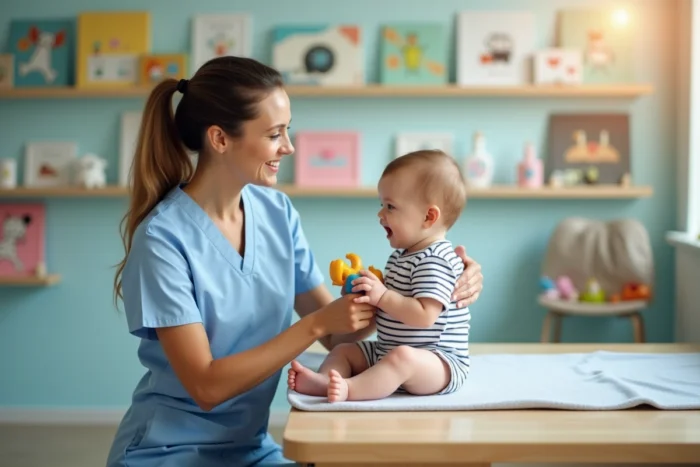
Cranial osteopathy for infants: a legal framework to know
Many parents consult an osteopath in the first weeks of their baby’s life. In France, an osteopath who is not a doctor cannot manipulate the skull of an infant under six months without written authorization from a doctor. This rule, often unknown, aims to protect newborns whose cranial structures are still fragile.
Before making an appointment, check that the practitioner complies with this legal obligation. A medical osteopath is not subject to the same restriction, which sometimes creates confusion. Asking the professional directly remains the safest way to ensure that the consultation takes place in a secure framework.
The development of a baby relies on a combination of daily actions whose effects accumulate. Early skin-to-skin contact remains, among the documented factors, the one with the best-established measurable cognitive impact at five years. Dietary choices, sleep environment, and language stimulation complement this foundation, without a rigid hierarchy among them.