
The FFPJP points system does not simply reward victory. It weighs each result according to the level of the competition, the number of participants, and the category of the event. Understanding this mechanism allows players to target competitions where the effort/points gained ratio is most favorable.
Threshold of 32 participants and multiplier coefficient by competition level
A competition only generates categorization points if it includes at least 32 players or teams. Below this threshold, performance is simply not counted, regardless of the outcome. We recommend systematically checking the number of participants before committing to a distant tournament.
The scale then varies according to the level. A departmental competition with 32 teams does not award the same volume of points as a national or supra-national competition with a comparable number of participants. The level of the competition weighs as much as the final ranking in the calculation. A quarter-final in a national competition can yield more points than a victory in a sparsely attended departmental event.
To fully understand the calculation of FFPJP pétanque points, it is essential to recognize that the scale evolves in tiers based on the number of participants: the more participants in the competition, the more each round completed earns. The jump in points between a competition with 32 participants and one with 64 or more is significant.

FFPJP categorization points: scales by type of event
The FFPJP distinguishes several families of events, each with its own scale. The “All Categories” competitions (Senior and Mixed) form the main base for point accumulation for the majority of license holders.
Specific events (Promotion, Veteran, Jeu Provençal, Women, Youth) have distinct scales. Points earned in Promotion do not accumulate in the same way as those obtained in All Categories. A player who participates in multiple Promotion competitions without ever registering in All Categories mechanically caps their progression towards Honor.
Qualifying rounds and championships: the main lever
The qualifiers for the Departmental, Regional, League, and National Championships generate points that are higher than those from open competitions. A complete run in the qualifying phase, even without a final title, can be enough to cross a categorization threshold.
We observe that many competitors neglect the departmental qualifiers in favor of more prestigious national events. From a strict points/played matches ratio perspective, qualifiers remain the most effective means of progressing in category.
FFPJP Classification: thresholds for moving between categories
The system classifies players into four levels: Unclassified, Promotion, Honor (divided into Honor 1 and Honor 2), and Elite. The classification is recalculated each year based on the results of the previous season.
- The transition from Unclassified to Promotion is based on a minimum accumulation of points in All Categories competitions, accessible after just a few regular results in events with 32 participants or more.
- The Promotion to Honor 1 threshold requires a significantly higher volume of points, primarily obtained from well-attended regional or national competitions.
- Access to Honor 2 and then Elite depends on both the accumulated points and significant results in high-level events (championships, supra-national, international).
- Some notable results (departmental, regional, or national championship titles) lead to direct classification in a higher category, regardless of the points accumulated.
A significant result outweighs the accumulation of points: a championship title can directly propel a player into a higher category without having reached the threshold through accumulation.
Tie in points during a round: the three cases of the official rules
When discussing “points” in pétanque, confusion often arises between points scored (game score) and categorization points (federal ranking). On the field, the awarding of points during a tight round follows precise rules that the official regulations clarify in three distinct situations.
- If two opposing balls are strictly equidistant from the jack and both teams still have balls to play, the team that played last must replay until they take the point or exhaust their balls.
- If the two closest balls are equidistant and neither team has any balls left, the round is null: no points are scored, and the jack is re-thrown by the same team.
- If only one team still has balls and the tie persists, they play their remaining balls to try to score additional points.
A null round awards no points to either team. This case, seemingly rare, occurs regularly in tight competition and can influence the final score of a knockout competition.
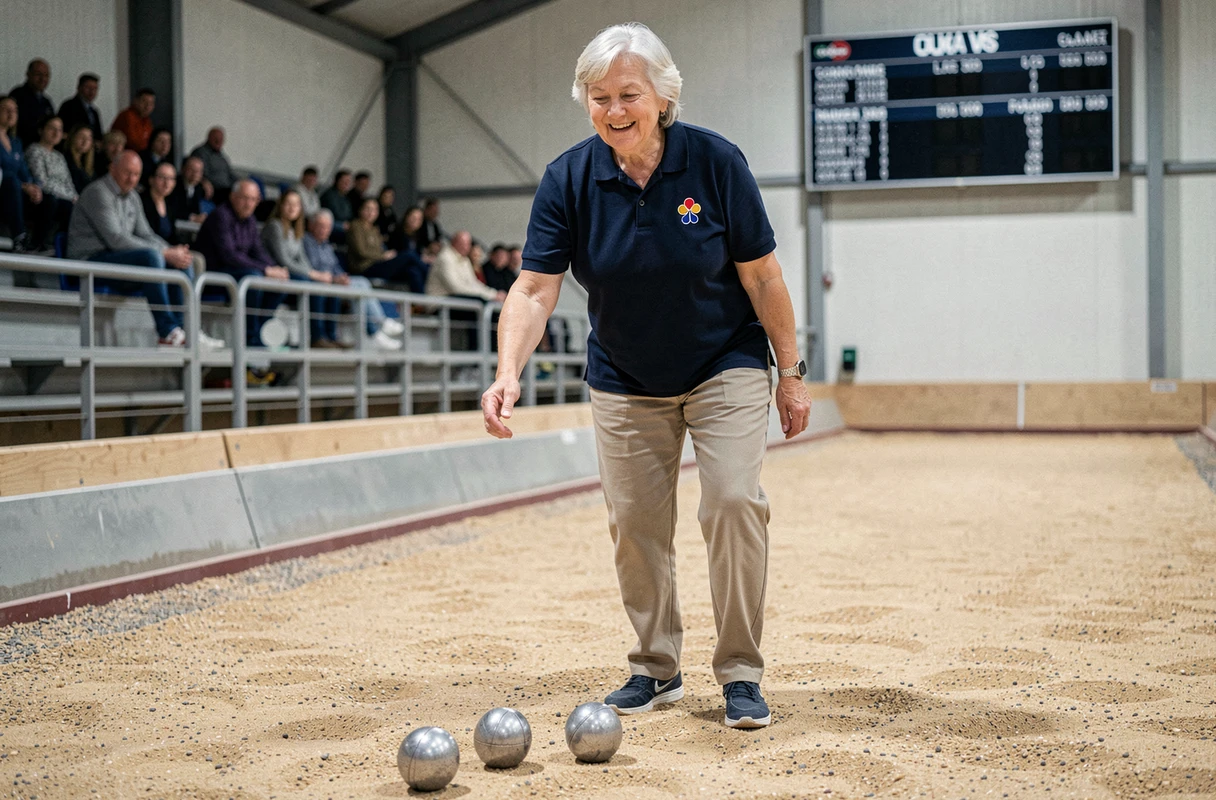
Check your FFPJP points: mobile app and GESLICO
The FFPJP has restricted access to points data via third-party sites. Consultation now goes through two official channels: the GESLICO database (accessible with the 8-digit license number) and the mobile app “My FFPJP License,” available on the App Store.
The app allows users to track the evolution of their points and categorization in real-time. Third-party sites like Boulipédia can no longer display the FFPJP form, making the official app or GESLICO the only reliable means of verification.
Seasonal tracking strategy
We recommend checking your points after each qualifying competition rather than at the end of the season. Regular tracking allows for adjustments to the competition schedule: if the threshold for moving to a higher category is close, directing your entries towards competitions with a high coefficient (national, supra-national) can make a difference in the final weeks.
The calculation of categorization points is based on stable rules, but their practical application varies by department and federal calendar. The only variable that the player controls remains the choice of competitions and the regularity of their entries in eligible events.