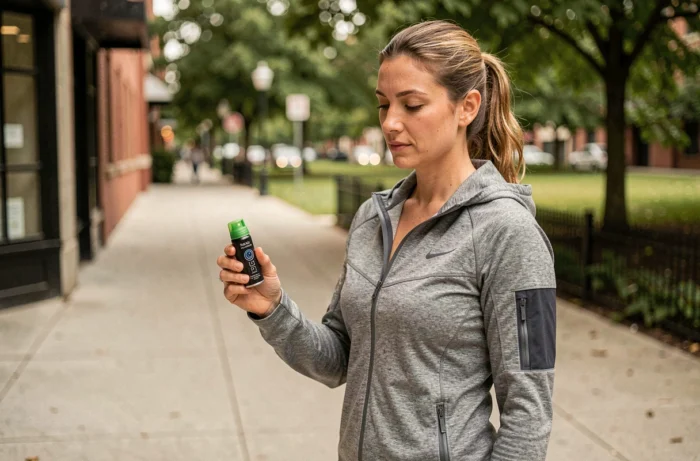
Decathlon does not sell any defense aerosol. Neither CS tear gas nor OC pepper spray nor incapacitating gel: the brand’s catalog is limited to sports equipment. This confusion, fueled by numerous online queries, needs to be clearly addressed before discussing the technical criteria that truly guide the choice of a personal protection device.
Gel or gas indoors: often ignored ballistic constraints
The choice between gel and gas is not a matter of comfort preference. In confined spaces (apartment, underground parking, stairwell), a CS gas aerosol saturates the ambient air in a matter of seconds. The user then suffers from cross-contamination that reduces their own ability to evacuate the area.
The gel, whether based on CS or OC, significantly limits this dispersion. Its projection forms a coherent jet that sticks to the target without creating an airborne cloud. We systematically recommend gel for any use in enclosed environments.
Outdoors, the situation changes. A gas spray covers a wider diffusion cone, which allows for aiming errors under stress. Wind remains the determining factor: against a gust, gas returns to the user, while gel maintains its trajectory. If you are looking for a Decathlon tear gas and pepper spray suitable for your needs, it is this type of technical distinction that should guide your decision, not the name of a brand.
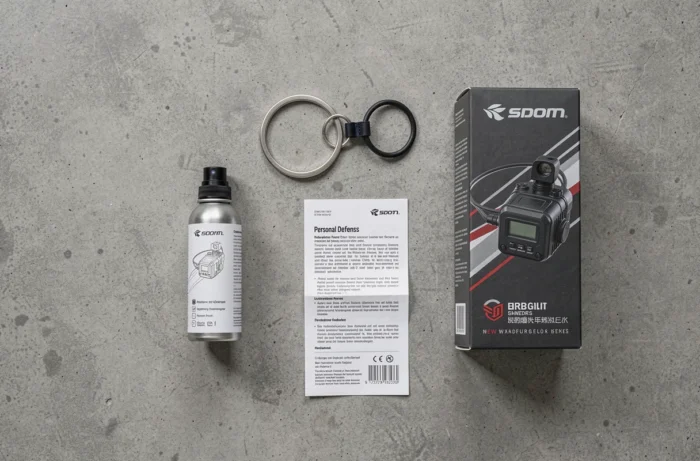
CS active agent vs. OC: different incapacitation profiles
CS (orthochlorobenzylidene malonitrile) primarily affects the ocular and respiratory mucous membranes. Its effect is rapid, with an action delay of a few seconds, but CS does not work on individuals under heavy influence of alcohol or drugs. The altered nervous system partially blocks the tear response.
OC (oleoresin of capsicum, pepper extract) triggers an inflammatory reaction independent of the central nervous system. OC remains effective on intoxicated individuals, making it the preferred agent for security professionals. The inflammation of the eyelids forces the eyes to close through a purely physiological mechanism.
Some manufacturers combine CS and OC in the same aerosol. This dual formulation accumulates the modes of action but also increases the risk of contamination for the user in case of product backflow. For an individual, pure OC gel offers the best compromise between effectiveness and safety of use.
Category D and legitimate reason: the distinction imposed by law
Legally purchasing a defense aerosol does not grant the right to carry it on one’s person. This nuance, codified in the Internal Security Code, escapes the majority of buyers. Aerosols with a capacity of 100 ml or less belong to category D. Their purchase and possession at home are free for any adult, without declaration or authorization.
Carrying outside the home follows a completely different logic. One must justify a legitimate reason assessed on a case-by-case basis by law enforcement or the judge. The mere desire to defend oneself does not constitute a recognized reason in itself. A professional exposed to documented risk (cash transporter, real estate agent working alone in the evening) has a valid argument. An individual returning from dinner, much less so.
- Carrying without a legitimate reason: risk of prosecution that can lead to up to one year in prison and a fine of 15,000 euros.
- Aerosols exceeding 100 ml: classified in category B, subject to prefectural authorization, inaccessible to individuals.
- Remote impulse pistols (like Taser projection): prohibited for civilians regardless of capacity or power.
Evolution of the penal framework and carrying category D weapons
The context of use now weighs as heavily as the object itself in the penal qualification. Carrying a defense aerosol during gatherings or in circumstances likely to disturb public order constitutes an aggravating circumstance that courts increasingly take into account.

Criteria for selecting an effective defense spray
The market for defense aerosols is flooded with low-priced products whose concentration of active agent remains insufficient to produce real incapacitation. We regularly observe OC sprays with a capsaicin percentage that is too low to cause involuntary eye closure.
- Capacity: stay under 100 ml to remain in category D. Pocket sizes (25 ml) offer a compromise between discretion and the number of sprays available.
- Type of jet: cone (gas) for outdoors, directional jet (gel) for confined spaces. Adapt the format to your daily environment, not to a theoretical scenario.
- Safety system: an anti-accidental discharge cap is necessary for carrying in a bag or pocket. A spray that triggers from accidental pressure in a handbag becomes a problem, not a solution.
- Expiration date: active agents lose effectiveness over time. An expired aerosol may spray product without producing the expected incapacitating effect.
Price is not a reliable indicator of quality. Some models sold for a few euros on marketplaces have defective nozzles or concentrations of active agent that do not comply with the advertised specifications. Prioritizing manufacturers specialized in safety equipment rather than generalist sellers remains the only rational approach.
The reflex to seek this type of product from a sports distributor like Decathlon reflects a legitimate need for accessible protection. The answer lies with licensed gunsmiths, specialized personal defense websites, and certain professional security brands that guarantee the regulatory compliance of each product sold.