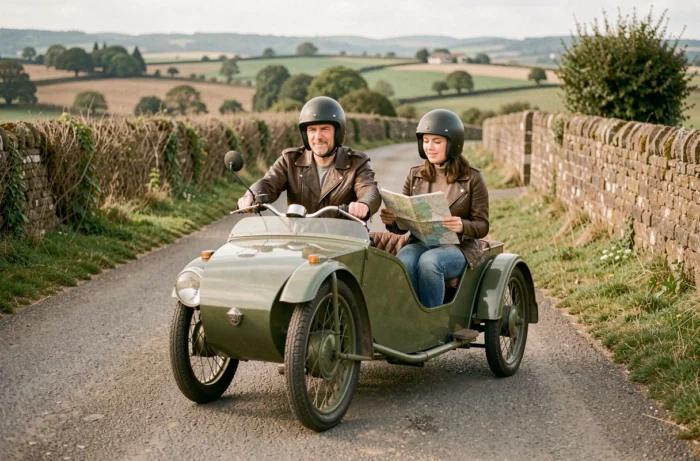
The answer lies in one line on the registration certificate, not in a universal rule applicable to all sidecars. The number of people allowed on board a sidecar strictly depends on the vehicle’s approval, that is to say, the seating capacity mentioned on the registration certificate. The most common configuration allows for two occupants (the rider on the motorcycle, the passenger in the sidecar), but some approved setups permit a third passenger on the rear seat.
Registration and Approval: The Only Document That Sets the Legal Capacity
The highway code does not set a generic number of seats for the sidecar category. It is the vehicle’s approval, reflected on the registration certificate, that determines how many people can legally be on board.
A sidecar is classified in category L4e. Adding a sidecar to a motorcycle does not change its classification (Article R311-1 of the highway code), but it constitutes a notable transformation of the bodywork. The registration certificate must then indicate “SIDE-CAR” or “SOLO/SIDE-CAR” depending on whether the sidecar is integrated or detachable.
Field S.1 (number of seating places) on the registration certificate is the only reference that can be enforced in case of a check. If the registration certificate indicates two seats, carrying a third person constitutes an offense, even if physical space allows it. In short, the actual capacity of the sidecar does not create any additional rights without corresponding approval.
We recommend checking this field before any second-hand purchase. On older models, the mention may be absent or ambiguous, complicating both insurance and roadside checks. In this case, the passenger of a sidecar will only be covered if the declared number of seats corresponds to the actual occupancy.
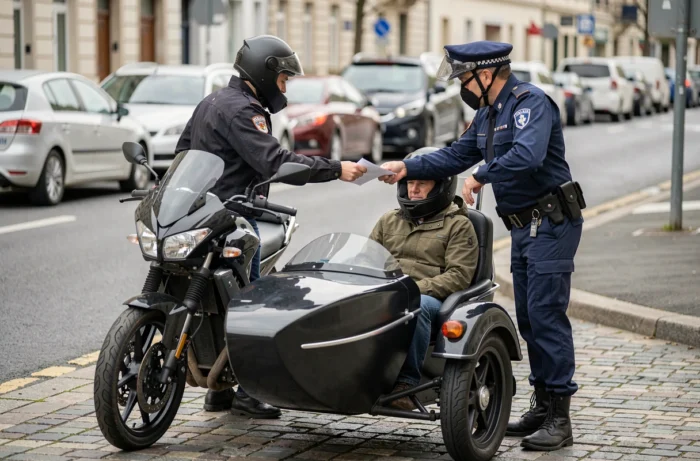
DREAL Approval and Modified Sidecar: When Is a New Approval Required?
Adding a seat in the sidecar, widening the seat, or welding a backrest frame is not considered tolerated tinkering. Any modification affecting the chassis, braking, weight, or load distribution per wheel triggers the obligation of a standalone approval from the DREAL.
The procedure requires presenting the modified vehicle, accompanied by a technical file detailing the changes. The DREAL checks compliance with European standards for category L4e, then issues (or refuses) a receipt report. Without this document, the registration certificate cannot be updated, and the vehicle operates illegally.
The cases we most often observe concern:
- The addition of a child seat fixed in the sidecar, which alters the load per wheel and sometimes the braking behavior
- Replacing a single-seat sidecar with a wider two-seat model, which sometimes exceeds the regulatory limit of two meters in overall width
- The installation of a seatbelt or harness not originally intended, considered a modification of the bodywork
In summary, any added seat without DREAL approval is legally nonexistent. The passenger occupying it is neither insured nor legally transported.
Transporting a Child in a Sidecar: Specific Legal Framework
A child counts as a full passenger. No exemption allows placing two children on a seat approved for one person. Sidecar tourism operators apply this rule without exception: one passenger per seat, regardless of age.
Wearing a helmet is mandatory for the passenger in the sidecar, including for a child. The addition of a sidecar to a motorcycle does not change the vehicle’s classification, so the obligations related to motorcycles (approved helmet, gloves for the rider) remain applicable.
The question of a booster seat or an appropriate child seat is not subject to any specific regulations for sidecars, unlike cars. In practice, we recommend a restraint device suitable for the child’s morphology, securely attached to the sidecar’s chassis and compatible with the vehicle’s approval. A standard car seat bolted to the floor of the sidecar may constitute a notable modification, with the administrative consequences described above.
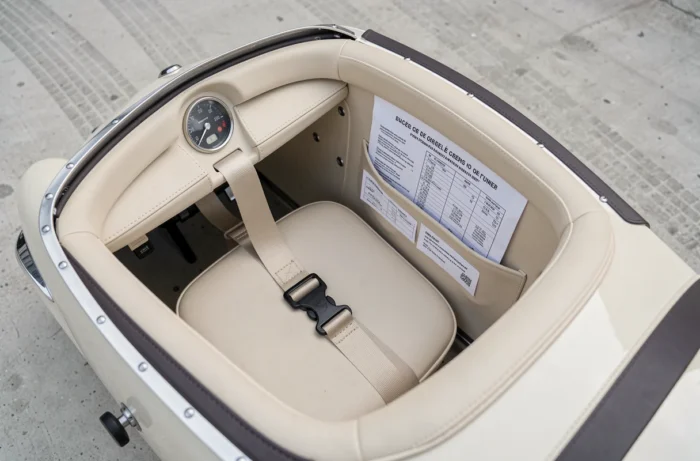
Overall Width and Seats: The Technical Constraint That Sidecarists Forget
Article R312-10 of the highway code limits the overall width of vehicles to two meters for motorcycles, including sidecars. This dimensional constraint directly affects the size of the sidecar and, by extension, the number of seats that a manufacturer can approve.
An approved two-seat sidecar often approaches this limit. Beyond that, the vehicle falls outside category L4e and is subject to a different regulatory framework, with different braking, lighting, and signaling requirements. This is why the vast majority of production sidecars remain approved for two people in total (rider plus one passenger in the sidecar).
Three-seat configurations exist: rider, sidecar passenger, rear seat passenger. They assume that the motorcycle has an approved passenger seat and that the registration certificate explicitly mentions three seats. This setup remains rare, as it adds weight to the whole and significantly alters dynamic behavior, particularly in left turns where mass displacement increases.
Compliance with the overall width is not just an administrative formality. An overly wide sidecar complicates passage in narrow lanes, alters the dimensions perceived by other road users, and can lead to the vehicle being immobilized during a technical or roadside check.
The legal number of passengers in a sidecar is indicated on the registration certificate, validated by approval, and limited by the vehicle’s geometry. Before carrying an additional passenger, the only reliable step is to check field S.1 of the registration certificate and, in case of doubt, to consult the DREAL for standalone approval.