A lipstick applied directly to the lips rarely lasts more than two hours and often bleeds into fine lines. Lip liner addresses these two issues, provided you choose the right shade and apply it in the correct order. Pairing a lipstick with a lip liner requires minimal tools, but a few precise steps can change the entire outcome.
Shade Difference Between Liner and Lipstick: The Rule to Avoid the Line Effect
Have you ever noticed a sharp demarcation between the outline and the rest of the lips in some makeup looks? This visible circle almost always results from too great a color difference between the liner and the lipstick.
The liner should be half a shade to a shade darker than the lipstick. Not more. A dark brown liner under a coral lipstick creates an artificial boundary that even blending cannot fix.
To check compatibility, draw a line of liner on the back of your hand, then apply the lipstick right next to it. If the transition appears smooth in natural light, the duo works. If you see two distinct bands, the contrast is too strong.
Recent trends confirm this shift: the desired effect is no longer a highly contrasted outline, but soft and blended edges towards the center of the lip. A liner slightly deeper than the natural shade, blended towards the center, followed by a lipstick or tinted balm applied on top gives a modern result without a “circle” effect. Knowing how to pair lipstick with liner primarily relies on this shade agreement.
Matte Liner, Shiny Liner, or Volumizing Liner: Which Type for Which Lipstick Texture
The classic firm and matte liner remains the most common. It is suitable for matte and satin lipsticks because its dry texture grips the pigment and prevents it from sliding.
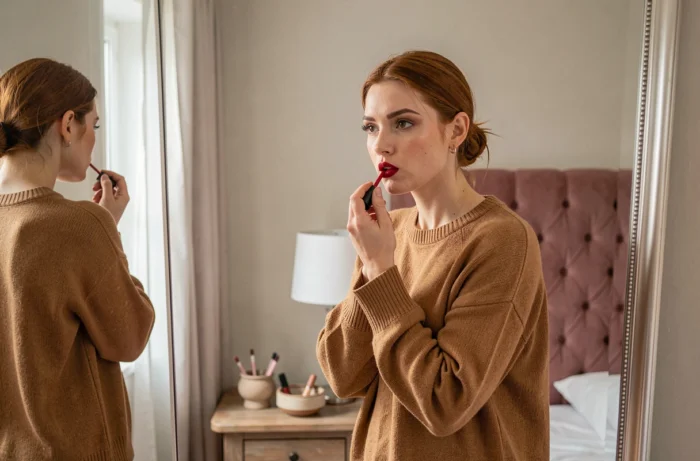
Brands are now expanding their offerings with shiny liners and volumizing formulas. These recent references do not work the same way as traditional liners, and pairing them with the wrong lipstick creates a messy result.
- Matte liner + matte or satin lipstick: the most reliable combination for longevity. The liner acts as a dry barrier, allowing the lipstick to adhere without migrating. Ideal for a structured lip that needs to last all day.
- Creamy liner + satin lipstick or tinted balm: the liner blends better with the color, making blending easier. The result is more natural, but the longevity decreases by about an hour compared to the matte duo.
- Shiny or volumizing liner + gloss: this duo focuses on shine and a plump effect. Longevity remains limited, but the visual result compensates. Avoid pairing a shiny liner with a matte lipstick: the two textures repel each other and create uneven areas.
The principle is simple: similar textures get along, opposing textures sabotage each other.
Application Order and Blending Technique for a Successful Lip Combo
Applying the liner after the lipstick is a common mistake. The liner applied first creates a framework that holds the color and prevents the pigment from bleeding into the fine lines around the mouth.
Outline Without Stiffening the Line
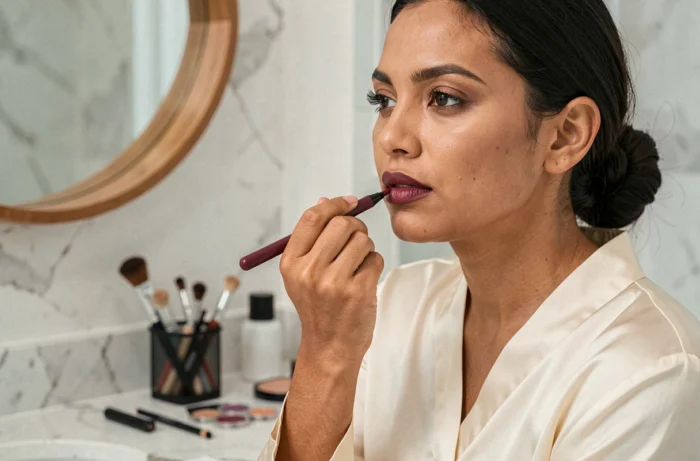
Start from the Cupid’s bow at the center of the upper lip, then move down towards the corners. Repeat on the lower lip starting from the center. Short little strokes provide a more precise outline than a continuous line.
Do not go more than a millimeter beyond the natural outline. Beyond that, the result looks drawn even after blending. To give a slightly fuller effect, this slight overflow is sufficient.
Fill in the Lip with Liner Before Lipstick
Once the outline is drawn, color the entire surface of the lip with the liner. This even base serves two functions: it intensifies the color of the lipstick applied on top and significantly prolongs its wear.
Then apply the lipstick starting from the center outwards. Dab rather than smear: two thin layers hold better than one thick layer.
Blend the Liner-Lipstick Junction
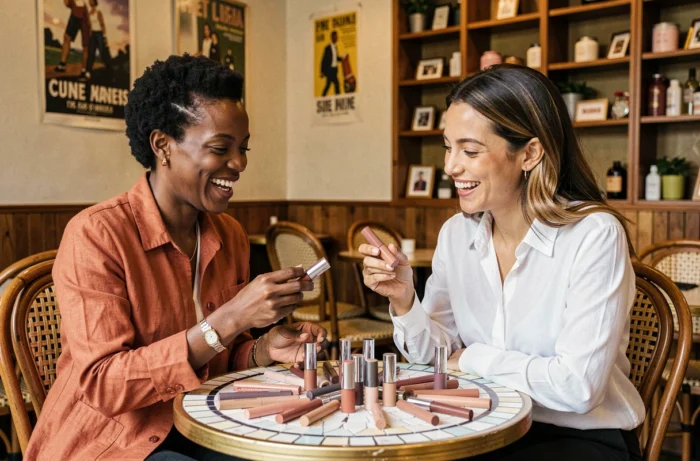
With a small lip brush or the tip of your finger, blend the boundary between the lip liner and the lipstick. The movement always goes from the outside towards the center of the mouth. This step takes ten seconds and eliminates the demarcation.
Pairing Lipstick and Liner Colors According to Skin Tone
The liner-lipstick duo does not work in isolation. The color must also match the skin’s undertone to avoid makeup that looks plastered on.
- Warm undertone (greenish veins on the wrist): favor peach pinks, corals, apricot nudes. A soft brick-toned liner complements these lipsticks well.
- Cool undertone (bluish veins): raspberry pinks, blue-toned reds, and purples work better. A cool pink or light plum liner serves as a cohesive outline.
- Neutral undertone: most shades are suitable. A rosy nude liner remains the most versatile all-rounder for this skin type.
The lip liner category has seen a marked resurgence since the return of 1990s beauty codes, with documented growth by Circana in the first half of 2025 in both prestige and mass markets. The range of available shades has never been broader, making it easier to find the perfect duo.
One last often-overlooked point: the color of the liner evolves on the lips over the hours, especially as the lipstick fades. Choosing a liner whose shade remains flattering on its own ensures a decent result even at the end of the day, without touch-ups.