
When bills pile up and the end of each month becomes an impossible equation, filing a debt over-indebtedness application with the Banque de France can represent a real way out. This free procedure allows you to freeze creditor actions and seek a solution tailored to your financial situation. However, you need to know how to properly prepare this application to avoid a rejection.
What really blocks debt over-indebtedness applications before review
The vast majority of applications submitted are accepted by the debt over-indebtedness commissions. This figure is reassuring, but it masks a problem upstream: many applications linger or return incomplete even before reaching the commission.
The main obstacle is not eligibility. It is the incomplete inventory of debts. Forgetting a personal loan taken out three years ago, failing to mention an authorized bank overdraft that has become permanent, or ignoring an unpaid rent debt, each of these omissions can delay processing.
The debt profile of households has also evolved in recent years. Revolving credit is declining in applications, while personal loans and debt buybacks are taking up more space. You can find the steps on Expert Finances for a detailed overview of the documents to gather based on your type of debt.
Take the time to list each creditor, even those for which you have lost the statement. A call to your bank or a check of your client area is often enough to find the exact amounts.
Supporting documents for the debt over-indebtedness application: the list that matters

The official form (cerfa n° 13594) constitutes the foundation of the application. You can fill it out online on the Banque de France website, send it by mail, or submit it in person at an agency. But the form alone is not enough: it is the attached supporting documents that determine the quality of your application.
Here are the documents to gather before you begin:
- Your last three bank statements, which allow the commission to understand your actual financial flows (income, withdrawals, recurring overdrafts).
- The amortization tables or latest statements for each ongoing loan, including personal loans, revolving credits, and debt buybacks.
- Proof of current expenses: rent receipts, utility bills, tax notices, and any document proving a non-bank debt (hospital, canteen, local taxes).
- A valid ID and a proof of residence dated within the last three months.
Each declared debt must be supported by a document. A simple handwritten list is not sufficient. If you cannot find a loan contract, request a duplicate from the lending institution. This delay is better than an application deemed incomplete.
Why the amount of disposable income deserves your attention
The commission calculates your “disposable income,” that is, the amount you have left after deducting unavoidable expenses. This amount directly determines the proposed solution: staggered repayment plan, deferral of certain deadlines, or in the most serious cases, partial debt forgiveness.
Underestimating your actual expenses works against you. Declaring a rent without mentioning the condominium fees or childcare costs skews the calculation. The commission works with what you provide.
Submitting the application online or at a Banque de France agency
You have the choice of three channels to submit your debt over-indebtedness application: online, by mail, or directly at a Banque de France agency (or with the IEDOM for overseas departments).
Online submission is the fastest. The Banque de France website allows you to complete the form step by step, attach digitized supporting documents, and sign electronically. You receive an immediate acknowledgment of receipt.
Submitting in person at an agency remains relevant if you need assistance. An advisor checks with you that the application is complete and can point out any omissions before sending it to the commission. This step is not mandatory, but it reduces the risk of missing documents.
Whichever channel you choose, the procedure is entirely free. No application fees, no paid intermediaries are necessary. Beware of services charging for the preparation of a debt over-indebtedness application: this is a process you can undertake alone or with the free help of a social worker.
After submission: admissibility decision and effects on your creditors
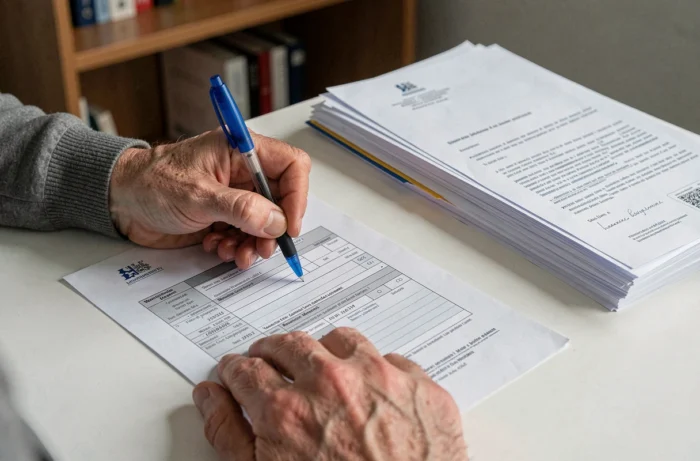
Once the application is received, the debt over-indebtedness commission has a period to examine its admissibility. During this phase, you have nothing to do except respond to any requests for additional information.
If the application is declared admissible, several effects are triggered automatically:
- Interest stops accruing on all your loans covered by the procedure.
- Seizures on your bank account or salary are suspended.
- No rejection fees for withdrawals can be charged to you during the procedure.
Your creditors are informed at this point, and not before. As long as the application is not declared admissible, no one is notified of your action.
In case of an inadmissible application
A rejection is not final. You have fifteen days to contest the decision before the judge of contentions of protection. The most common reason for rejection is a lack of good faith, for example, if the commission believes that the debt was incurred deliberately excessively.
You can also submit a new application after correcting the elements that led to the rejection. A better-documented application or one accompanied by a written explanation of the origin of the debts is sometimes enough to reverse the decision.
Submissions of debt over-indebtedness applications increased by 11% in the first eight months of 2026 compared to the same period in 2025, according to the monthly barometer of financial inclusion from the Banque de France. This increase shows that resorting to this procedure is nothing exceptional. The system exists precisely to allow individuals to regain financial balance, without shame or penalty.