A playful and educational activity is defined by its ability to produce learning (motor, cognitive, social) in a setting perceived as a game by the child. The distinction between “occupying” and “stimulating” lies in a simple parameter: the degree of active engagement of the child in the proposed task.
Children’s Daily Physical Activity: A Foundation Before Creative Leisure
The French guidelines relaying the WHO recommendations suggest about 60 minutes of physical activity per day for children and adolescents. This volume does not need to be achieved in a single session: it can be broken down into short segments spread throughout the day.
Before thinking about crafts or board games, the priority is to regularly interrupt sitting periods. An improvised motor course in the living room (cushions to jump over, a chair to go around, a target to aim at with a foam ball) engages balance and coordination without specific equipment.
Dance challenges work particularly well with families: each participant chooses a song and imposes a choreography on the others. Families looking for structured ideas around active play can explore the resources offered on stationkids.fr, where activities are designed to combine movement and learning.
Chasing games adapted for indoors (variations of tag, timed hide-and-seek) complement the setup when the weather prevents going outside. The French ICAPS study, recognized by the WHO, showed that a structured intervention combining family activity and reducing screen time yields better results than a simple screen ban.
Screen-free Educational Games: The Role of Concrete Manipulation
Learning through manipulation is based on a principle documented in educational sciences: a child retains more of what they build with their hands than what they passively observe. Three formats lend themselves particularly well to the family setting.
Scientific Cooking Experiments
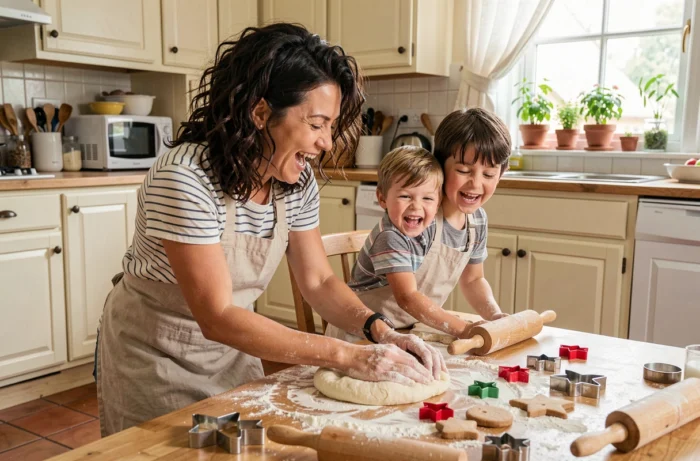
Mixing baking soda and vinegar to observe a fizzing reaction, measuring volumes with graduated cups, weighing ingredients while following a recipe: these actions introduce concepts of proportion, chemical transformation, and measurement. The adult supports by asking questions (“What happens if we double the amount?”) rather than providing the answer.
Free Construction and Engineering
Cardboard boxes, paper rolls, tape: recycled materials are sufficient for construction projects that last several days. Bridges, towers, imaginary vehicles – the technical challenge matters more than the aesthetic result. Setting a measurable goal (“build a bridge that supports the weight of a book”) transforms crafting into problem-solving.
Progressive Language Games
The endless sentence (each player repeats the sequence and adds a word) works on working memory. Riddles by description (describing an object without naming it) develop vocabulary and categorization skills. These games require no materials and adapt to all ages.
Calm Activities for Children Before Bedtime: Protecting Sleep
The High Council of Public Health recommends avoiding screens during the hour before bedtime and not placing them in the bedroom. This evening slot calls for calm activities that prepare the transition to sleep.
- Shared reading remains the most effective format: the adult reads aloud while the child follows the illustrations, which slows the heart rate and promotes falling asleep.
- Free drawing with colored pencils (no bright screens) allows the child to “empty” their day onto paper, a form of non-verbal debriefing.
- The collective storytelling, where each family member adds a sentence to an invented story, combines imagination and active listening without intense visual stimulation.
These three formats share a characteristic: they reduce light exposure and sensory stimulation in the last part of the day.
Family Treasure Hunt: Structuring a Game with High Educational Value
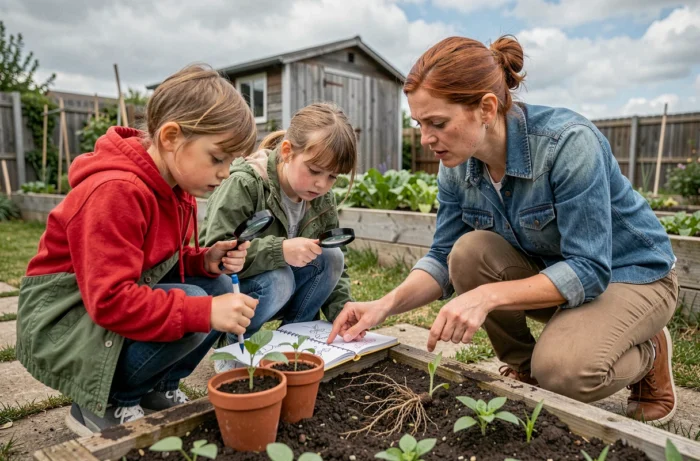
The treasure hunt goes beyond simple entertainment when it incorporates educational steps. Designing the clues oneself requires preparation investment, but the return in engagement from the children is disproportionate to the effort made.
An effective course relies on three types of alternating challenges:
- Age-appropriate logical puzzles (rebuses for younger ones, coded messages for older ones), which engage deductive reasoning.
- Short physical challenges (hopping on one foot to the next clue, crawling under a table) to maintain movement.
- Collaborative tasks where two children must cooperate to solve a problem, which works on communication and compromise.
The involvement of children in creating the game multiplies the educational value: a child who writes clues for their siblings engages in writing, planning, and theory of mind (anticipating what the other knows or does not know).
Adapting Family Activities According to Age and Safety
An activity proposed to a three-year-old does not have the same constraints as an activity for a nine-year-old. Regulations govern the safety of marketed toys, but they do not cover improvised activities at home. Two common-sense rules apply systematically.
Any small-sized materials (marbles, beads, caps) remain inaccessible to children under three years old due to the risk of ingestion. For activities involving scissors or sharp tools, direct supervision by an adult is not optional, even for children who “know how to cut.”
Age adaptation also concerns the expected duration of concentration. Proposing a 45-minute activity to a four-year-old generates frustration, not learning. Short sessions of 15 to 20 minutes, followed by a change of activity, better match the attention capacities of young children.
The last often overlooked parameter remains the fatigue of the accompanying adult. Alternating independent activities (drawing, free construction) with directed activities (treasure hunt, cooking experiment) allows for a full day without exhausting the supervising parent.