
You have just pushed open the door of an appliance store and are facing a row of refrigerators. On each one, a colorful label displays a letter. However, the price difference between a model rated C and another rated E may seem small, while the gap in the electricity bill is felt year after year. Understanding what the energy class of a fridge really means helps avoid a miscalculation at the time of purchase.
New A-G scale: why your old A+++ has become a C
Before 2021, refrigerators displayed classes ranging from A+++ to D. The problem: the vast majority of devices were concentrated in the A+ to A+++ classes. It was difficult to distinguish a truly efficient model from a merely acceptable one.
The European Union has therefore revamped the energy label by adopting a strict scale from A to G. The criteria have been tightened to the point that most refrigerators sold today fall into classes B to E, even when they are efficient. An old A+++ can now be found in class C or D on the new scale.
This recalibration has a clear objective: to leave room at the top of the scale for future innovations. If you are looking to understand the energy class of a fridge based on old benchmarks, you risk overestimating a device or dismissing a model that is actually very economical.
A fridge rated B or C in 2025 is already an efficient appliance. Aiming for A at all costs does not necessarily make sense: these models remain rare, and their higher cost is not always offset by the savings made over the appliance’s lifespan.
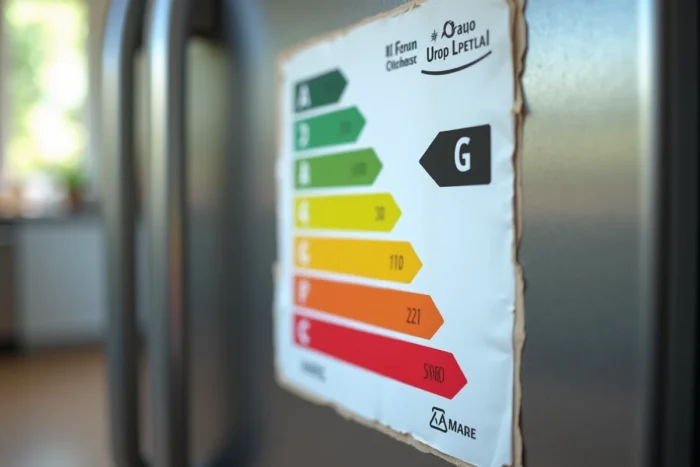
Reading the energy label of a refrigerator: the data that really matters
The colored letter catches the eye, but the label contains other equally useful information. Have you noticed the pictograms at the bottom of the label? They indicate concrete data that many buyers overlook.
Information to check on the label
- The annual consumption in kWh: this is the most directly comparable figure from one model to another. The lower it is, the less the fridge impacts the electricity bill.
- The usable volume of the compartments (refrigerator and freezer separately): a larger appliance consumes more, so comparing two fridges of different sizes based solely on the letter makes no sense.
- The noise level in decibels and its noise class (A to D): a criterion often overlooked that affects comfort in an open kitchen.
- The climate class: it indicates the range of ambient temperatures in which the fridge operates optimally, a point to check if your kitchen is poorly heated or, on the contrary, very exposed to heat.
Comparing two refrigerators solely based on their class letter is like comparing two cars based on their color. The number of annual kWh relative to usable volume provides a much more reliable picture of actual efficiency.
Consumption gap between classes: what it changes on the bill
The typical consumption of a domestic refrigerator varies from 200 to 800 kWh per year depending on size and class. In practical terms, a class E model can cost two to three times more in electricity than a class A or B appliance, for comparable use.
Over a lifespan of ten to fifteen years, this gap represents a significant amount. A slightly more expensive appliance at purchase but better rated can become the most cost-effective choice, provided that the price difference remains reasonable.
Let’s take a simple example. Between two combined models of similar volume, one rated C and the other rated E, the difference in annual consumption can reach several hundred kWh. Multiply by the price of kWh and by the number of years of use: the extra cost of purchasing a better-rated model is often recouped in just a few years.

Energy class and fridge size: the trap of oversized volume
An American refrigerator rated C consumes more than a small combined model rated E. The energy class measures relative efficiency compared to the category of the appliance, not its absolute consumption.
Before choosing, ask yourself a practical question: what volume do you actually need? A household of two people opting for a model over 400 liters will pay for the consumption of a largely empty space. Choosing the right size reduces the bill as much as moving up a class.
Some guidelines for sizing correctly:
- For one to two people, a total volume of 200 to 250 liters is sufficient in most cases.
- For three to four people, a combined model of 250 to 350 liters meets common needs.
- For more than four people or if you shop in bulk, a model of 350 to 500 liters is justified.
A well-sized fridge rated D will often be more economical in daily use than a giant model rated C but half empty. Real energy efficiency depends on the ratio between the used volume and consumption.
Fridge placement and settings: savings without changing the appliance
The energy class sets a potential consumption, but installation and daily use determine actual consumption. A refrigerator pressed against a wall without ventilation space at the back overheats and consumes more.
Leaving about ten centimeters between the back of the fridge and the wall, and avoiding placing it next to a heat source (oven, radiator, south-facing window), measurably reduces consumption. The thermostat setting also plays a role: a temperature of 4 °C in the main compartment is sufficient to keep food safe without forcing the compressor.
A well-rated appliance but poorly installed will consume more than a less well-rated model placed under good conditions. The letter on the label tells only part of the story: the rest depends on where you plug in your fridge and how you use it on a daily basis.