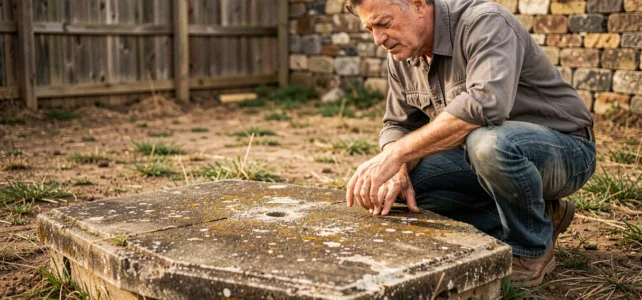
An old septic tank only treats wastewater from toilets. Household wastewater (kitchen, bathroom, washing machine) is discharged without any treatment. This technical distinction, often misunderstood, solely determines the regulatory status of the installation and the work to be planned.
Settling and anaerobic fermentation: what really happens in the tank
The operation of an old septic tank relies on two successive physicochemical mechanisms. The first, settling, separates solid materials by gravity: heavy sludge falls to the bottom, while fats and light materials form a scum layer on the surface. Between the two, a zone of relatively clarified water forms.
The second mechanism, anaerobic fermentation, occurs in the accumulated sludge. Bacteria work in the absence of oxygen to partially decompose organic matter. This process produces gases (methane, hydrogen sulfide) that must be evacuated through a properly sized ventilation system. Without this evacuation, the gases cause foul odors and can degrade the tank’s seals.
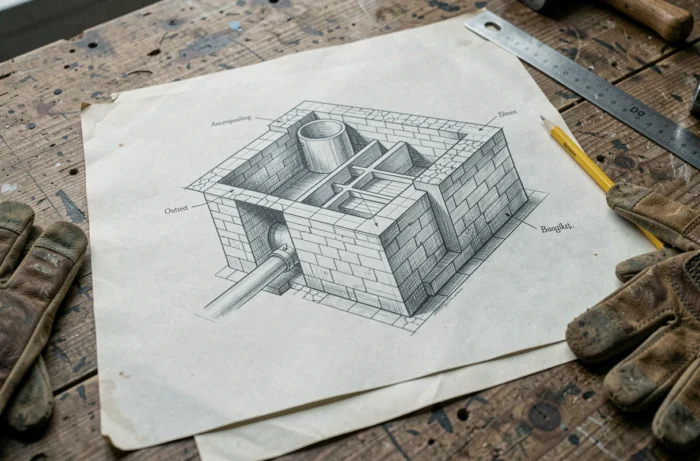
Understanding the diagram of an old septic tank allows for the localization of each element: inlet pipe, main tank, possible pre-filter, outlet pipe to a drainage system or a soakaway.
The outlet of the tank does not deliver clean water. It produces a partially clarified effluent that requires additional treatment in the soil (drainage trenches, sand filter). Without this downstream treatment, soil and groundwater pollution is direct.
Old septic tank vs. all-water tank: table of technical differences
The confusion between septic tanks and all-water tanks remains common. Both systems share the same principle of settling, but their treatment scope differs radically.
| Criterion | Old septic tank | All-water tank |
|---|---|---|
| Treated water | Wastewater (toilets only) | All domestic wastewater |
| Household wastewater | Discharged without treatment (soakaway, ditch) | Collected and treated in the same tank |
| Authorized installation | Prohibited since the decree of September 7, 2009 | Only approved system for new installations |
| Ventilation | Often absent or undersized | Mandatory with roof extractor |
| Grease trap | Sometimes present upstream | Recommended if pipe > 10 m |
| SPANC compliance | Non-compliant by definition | Compliant if properly sized and maintained |
The determining factor is the collection scope. An old septic tank, even in good structural condition, cannot be made compliant by simple maintenance: it does not treat gray water. The SPANC considers this situation as a certain non-compliance even before the inspection visit.
SPANC control and sanitation diagnosis: stable rules in 2026
Several online contents suggest that a recent national deadline would automatically render old tanks illegal. In reality, the rules for control and validity of diagnoses have remained stable for several years. The 2009 decree and the 2012 regulation still constitute the applicable framework.
SPANC intervenes at several points: during the design of a new installation, during construction, during periodic inspections, and systematically in case of sale. The sanitation diagnosis, mandatory during a real estate transaction, must be less than three years old.
If the diagnosis reveals a non-compliance, the buyer has one year after signing the deed to carry out the necessary work to bring it up to standard. However, outside of a sale, no binding deadline requires replacing an old tank as long as SPANC has not classified it as presenting a proven health or environmental hazard.
Situations classified as priorities by SPANC
- Direct discharge of untreated effluents into a watercourse, ditch, or surface of the land
- Total absence of a treatment system downstream of the tank (neither drainage nor sand filter)
- Proven pollution of a well or drinking water source located nearby
- Installation posing risks to public health (backflows, persistent odors)
Maintenance and emptying of an old septic tank: actions that extend its lifespan
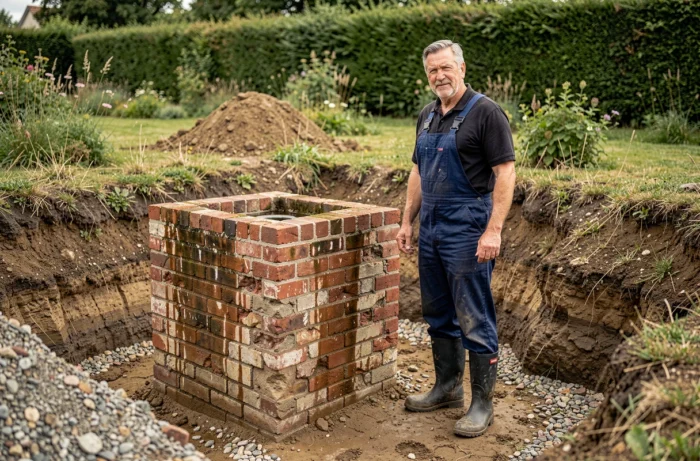
Even if destined for replacement, an old septic tank requires regular maintenance as long as it remains in service. The emptying should be carried out as soon as the sludge reaches half the useful volume of the tank. In practice, this corresponds to an interval of a few years depending on the household’s usage.
The emptying must be performed by an approved professional who provides a waste tracking slip. This document serves as proof of maintenance required by SPANC during inspections.
What should never enter the tank
- Antibacterial products and excessive bleach, which destroy the bacterial flora necessary for fermentation
- Wipes, even labeled “biodegradable,” which clog pipes and the pre-filter
- Cooking oils and food fats, which thicken the scum layer and reduce the useful volume
- Solvents, paints, and medications, which contaminate the sludge and make treatment at the station more expensive
A common warning sign is the appearance of abnormally dense vegetation above the drainage area. This excessive growth indicates that the effluents are saturating the soil with nutrients, a sign of a malfunction in the system or advanced clogging.
Monitoring the condition of the inspection openings remains the simplest preventive action. A blocked opening prevents visual inspection of the sludge level and complicates any emptying intervention. For an old installation whose replacement is not immediate, these regular visual checks remain the best protection against silent degradation of the system.