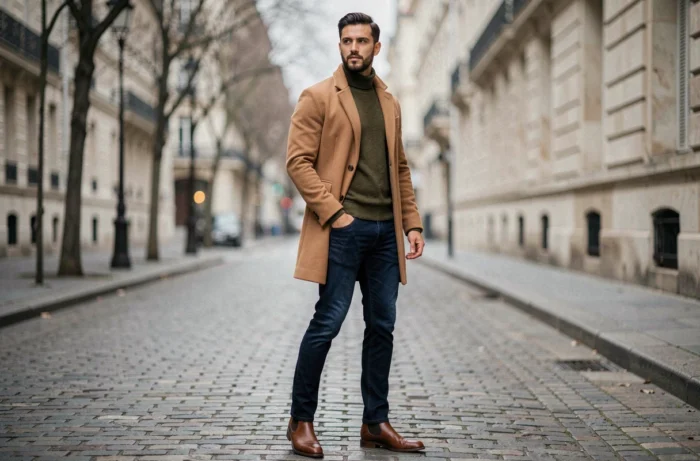
The autumn 2026 season redistributes the codes of the men’s wardrobe across three axes that are rarely covered by traditional trend magazines: the return of horizontal stripes outside the nautical context, the rise of the quarter-zip as a key piece between office and leisure, and the imminent arrival of the European digital passport on textile labels. Three topics that concretely change the way to compose a men’s look this season.
Horizontal stripes in layering: a pattern that moves away from the nautical wardrobe
Horizontal stripes are no longer confined to the sailor’s shirt. We are observing their migration to high-neck sweaters, long-sleeve polos, and technical tops worn as mid-layers. Lyst noted in September 2026 this diffusion of the pattern in hybrid silhouettes, far from the coastal cliché.
The key lies in the structured layering of stripes. A striped top slipped under an unstructured boiled wool jacket or an oversized blazer creates a contrast of registers that breaks the monotony of the dominant neutral shades (chocolate, taupe, anthracite). The pattern acts as a focal point in an otherwise monochromatic outfit.
On mister-tendance.fr, variations of this type of striped pieces are multiplying, confirming that the pattern has moved beyond the micro-phenomenon of streetwear to settle into mainstream ready-to-wear.
Two technical precautions: prioritize stripes with spacing greater than one centimeter to avoid an overwhelming optical effect on wider body types, and choose sufficiently dense knits so that the pattern retains its sharpness after several washes. Cotton-wool blends hold up better than pure cotton in this regard.
Men’s quarter-zip: the piece that redefines the professional dress code
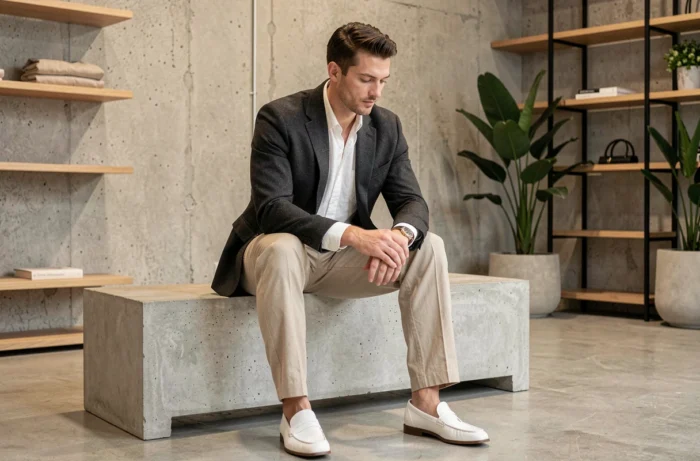
The quarter-zip has established itself as a credible alternative to the turtleneck and shirt in semi-formal work environments. Business Insider noted in September 2026 that searches for this piece are still dominated by Ralph Lauren, while Alo Yoga is gaining ground, signaling a blurring of the lines between office codes and athleisure aesthetics.
What makes the quarter-zip relevant this season is its ability to function as a standalone layer at the office or as a mid-layer outdoors. It replaces the V-neck sweater without falling into the purely sporty realm. The quarter zip offers a modifiable collar adjustment that classic knits lack.
Materials and cuts to target
- Versions in fine merino or blended cashmere can be worn under a sport coat without adding bulk to the shoulders, unlike overly voluminous technical fleeces.
- Slightly fitted cuts at the bust with a straight base (not elasticated) allow the piece to be worn tucked in or out of the pants without distorting the silhouette.
- Colors like taupe, anthracite, and navy dominate the season’s palette and integrate seamlessly into a weekly rotation of professional outfits.
We recommend avoiding models with oversized logos on the chest. The quarter-zip draws its strength from its discretion: a piece that structures the outfit without commenting on it.
Textile digital passport: what the European regulation changes for men’s style
The European regulation on the eco-design of sustainable products (Regulation (EU) 2024/1781), in effect since July 18, 2024, establishes the legal framework for the digital passport of products. The specific requirements for textiles are not yet legally finalized, but the infrastructure is progressing.
In practical terms, each garment could eventually carry a QR code providing access to its materials, manufacturing origin, reparability, and end-of-life options. For the informed consumer, this is a lever for both stylistic and ethical choice: traceability becomes a selection criterion on par with fit.
Impact on brands and wardrobe pieces
Brands that anticipate this requirement are already investing in the transparency of their supply chains. This favors pieces made from identifiable fibers (linen, wool, organic cotton) at the expense of complex synthetic blends whose composition remains unclear.
For a long-lasting men’s wardrobe, this means prioritizing accessories and garments whose material quality is verifiable. Jacquard patterns and thick wool knits, which are very present this season, lend themselves well to this logic: these are pieces whose artisanal or semi-artisanal production allows for more readable traceability than mass-produced basics.
Men’s colors and accessories autumn 2026: composing a coherent palette
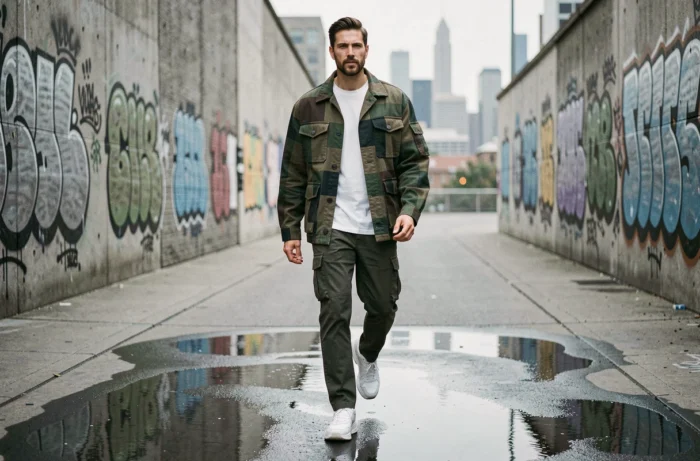
The autumn palette converges around six shades: chocolate, taupe, ecru, anthracite, navy, and burgundy. This chromatic tightening simplifies the construction of a coherent look but requires playing with textures to avoid monotony.
A pair of taupe corduroy pants paired with an anthracite quarter-zip and a faded burgundy leather jacket covers three distinct textures within a compatible color spectrum. Grain leather or suede shoes extend this tactile logic.
High-value accessories
Checked scarves return as a transitional piece between the bare neck and the thick scarf. Worn simply knotted or slipped into the collar of a coat, they add a discreet pattern without overwhelming the silhouette. Models in fine wool or blended cashmere offer the best compromise between warmth and finesse.
On the footwear side, the trend leans towards hybrid silhouettes between hiking sneakers and derbies. The rugged rubber soles provide a heavier visual base that balances the loose cuts on top.
Responsible men’s fashion also involves choosing second-hand pieces for certain leather accessories or vintage jackets. A quality garment bought second-hand remains more elegant than a poorly cut new one, and this approach aligns with the traceability logic that the digital passport will formalize.
Unique style does not rely on the accumulation of trendy pieces but on mastering three or four strong axes, worn consistently. This season, layered stripes, a well-chosen quarter-zip, and a tightened palette are enough to build a readable and personal men’s wardrobe.