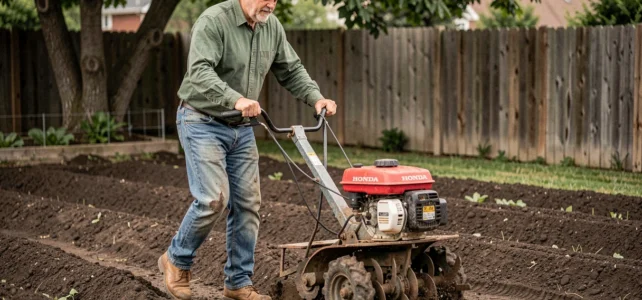
The Honda FG 320 is a thermal tiller equipped with the Honda GP160H 4-stroke engine, featuring a working width of 80 cm and a tilling depth of up to 33 cm. It has two speeds (forward and reverse) and is aimed at medium to large vegetable gardens. Before placing an order, several technical points deserve careful consideration.
Honda GP160 Engine: What Reliability Really Means
The term “reliability” appears in almost all reviews of the FG 320, but it covers a specific reality. The Honda GP160 engine is a 4-stroke engine with a horizontal shaft, designed for regular amateur use over several seasons.
Field feedback consolidated in recent comparisons shows a clear trend of fewer serious breakdowns (engine failure, major carburetor failure) compared to generic engines like Loncin or Lifan over periods of three to five years of use. This difference translates into reduced maintenance costs over the machine’s lifespan.
A reliable engine does not exempt one from rigorous maintenance. Oil changes, air filter cleaning, and spark plug checks remain operations to be performed according to the manufacturer’s recommendations. Neglecting these tasks, even on a Honda engine, eventually leads to avoidable malfunctions. As detailed in our review of the Honda FG 320, the longevity of the GP160 directly depends on the diligence of its owner.
Two-Speed Transmission: Real Advantage or Marketing Argument
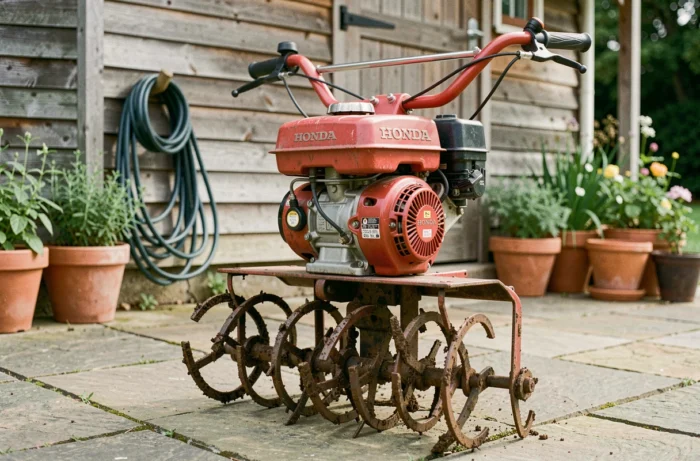
The presence of a forward and reverse gear distinguishes the FG 320 from most compact tillers, which only offer forward drive. The reverse gear is not just for backing up at the end of a row.
On clay or rocky soil, the tines can get stuck. Without reverse, one has to lift the machine or pull it manually backward, which strains the back and wastes time. The reverse gear of the FG 320 allows for easy clearing of the tines, then resuming work.
This transmission also alters maneuverability in tight spaces. In a vegetable garden bordered by boards or low walls, being able to maneuver without lifting the device changes the quality of work. For areas under 200 m² on already loose soil, this feature remains more of a comfort than a necessity.
Working Width and Depth: Adapting the FG 320 to Your Terrain
With a working width of 80 cm, the FG 320 covers a wide row in a single pass. This is a clear advantage for vegetable gardens spanning several hundred square meters, where the number of passes determines the total time for soil preparation.
An 80 cm width becomes a disadvantage in narrow plots or tight flower beds. If the garden mainly consists of 60 cm wide growing beds, the machine simply cannot fit between the borders. One must then check the possibility of removing tine elements to reduce the width, which some tillers allow and others do not.
The tilling depth, advertised at 33 cm, is suitable for plowing a traditional vegetable garden. For shallow tilling (5 to 10 cm), it is sufficient to adjust the rear brake spur. This adjustment controls the penetration of the tines into the soil and allows the machine to be used for both deep work and simple surface loosening.
Soils Involved and Limitations
The FG 320 works effectively on loose to moderately compact soils. On heavy, unworked clay soil, the GP160 engine reaches its limits: the available torque does not compete with that of a wheeled tiller with gear transmission.
For dense fallow land, a tiller like Staub or equivalent is more suitable. However, the FG 320 excels in a well-maintained vegetable garden, where the soil has already been loosened at least once each season.
Noise Level and Regulations: A Often Overlooked Parameter
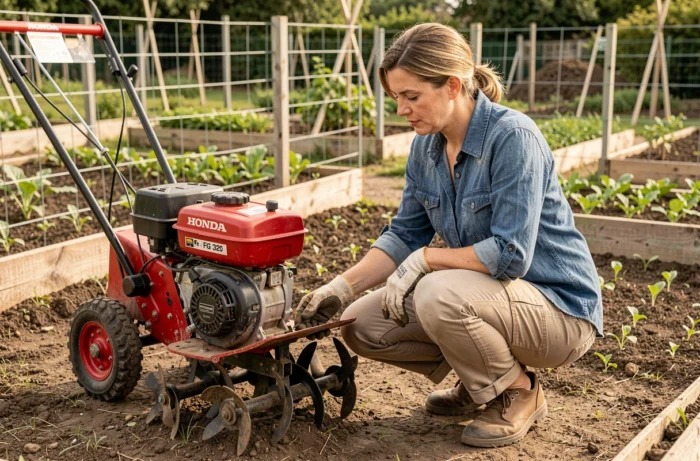
Thermal tillers produce significant noise. The FG 320, thanks to its Honda 4-stroke engine, remains within a more contained noise range than most competing generic engines. User feedback mentions less disturbance to neighbors compared to machines equipped with entry-level engines.
This relative discretion does not exempt one from adhering to usage hours set by municipal regulations. Most municipalities restrict the use of motorized gardening equipment to weekdays and Saturday mornings. Checking local regulations before using the machine near property boundaries helps avoid recurring neighbor disputes.
Criteria to Check Before Purchasing the Honda FG 320
Before confirming the order, a few checks can ensure that this tiller meets real needs:
- The area of the vegetable garden exceeds 200 m² and the soil has already been worked at least once, justifying a thermal machine of this category rather than an electric tiller.
- The width of the rows or growing beds allows for the passage of an 80 cm device, or it is possible to reduce the width of the tines.
- Storage is planned in a dry, ventilated space, as a thermal engine stored in a humid environment oxidizes prematurely.
- The budget includes suitable 4-stroke engine oil and a quality unleaded gasoline can, as degraded fuel quickly clogs the carburetor.
The question of the environmental acceptability of small thermal engines is increasingly being raised. Ongoing regulatory developments regarding emissions could, in the long term, alter the available offerings in thermal tillers. For a sustainable purchase, Honda’s engine benefits from a structured after-sales service network, which facilitates access to spare parts over the long term.
The FG 320 occupies a specific segment: too powerful for a small garden plot, not enough for fallow plowing. In a family vegetable garden maintained over several hundred square meters, it remains one of the most balanced tillers on the market, provided it is not asked to perform tasks for which it was not designed.