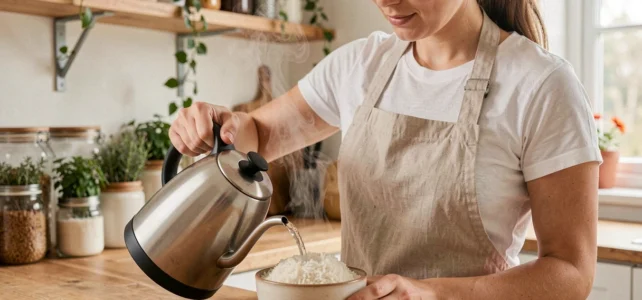
Hotel room without a kitchenette, student residence equipped with a single outlet, open-plan office during lunch hour: the electric kettle is often the only cooking appliance available. Cooking rice in a kettle is feasible, but the result depends as much on the model used as on the variety of rice chosen. Here’s what we tested, what works, and what poses problems.
Foam, overflow, and automatic shut-off: the real obstacles to cooking rice in a kettle
The first instinct when pouring rice into a kettle is to treat the appliance like a miniature pot. The problem arises quickly: the starch released by the grains creates foam that rises and triggers the thermostat’s automatic shut-off, sometimes in less than two minutes.
This phenomenon is more pronounced with short-grain rice (Japanese rice, round rice) which has a high starch content. Rinsing the rice three to four times before cooking significantly reduces the foam, but does not eliminate it completely. With a single-wall kettle and a basic thermal sensor, overflow remains likely as soon as you exceed half the kettle’s capacity.
Double-walled kettles and those with a lid that does not seal tightly perform better: steam escapes, pressure does not build up, and the foam subsides. You can also leave the lid slightly open, which prevents the steam sensor from cutting the cycle too early.
For those who want to delve deeper into the method and its variations, you can discover Gourmet Galopin in the kitchen on a dedicated guide to this topic.
Basmati rice, Japanese rice, brown rice: adapting the method to the type of grain
Not all rice reacts the same way to quick immersion cooking in a kettle. The choice of grain changes the water ratio, resting time, and risk of overcooking.
Basmati rice and long grains
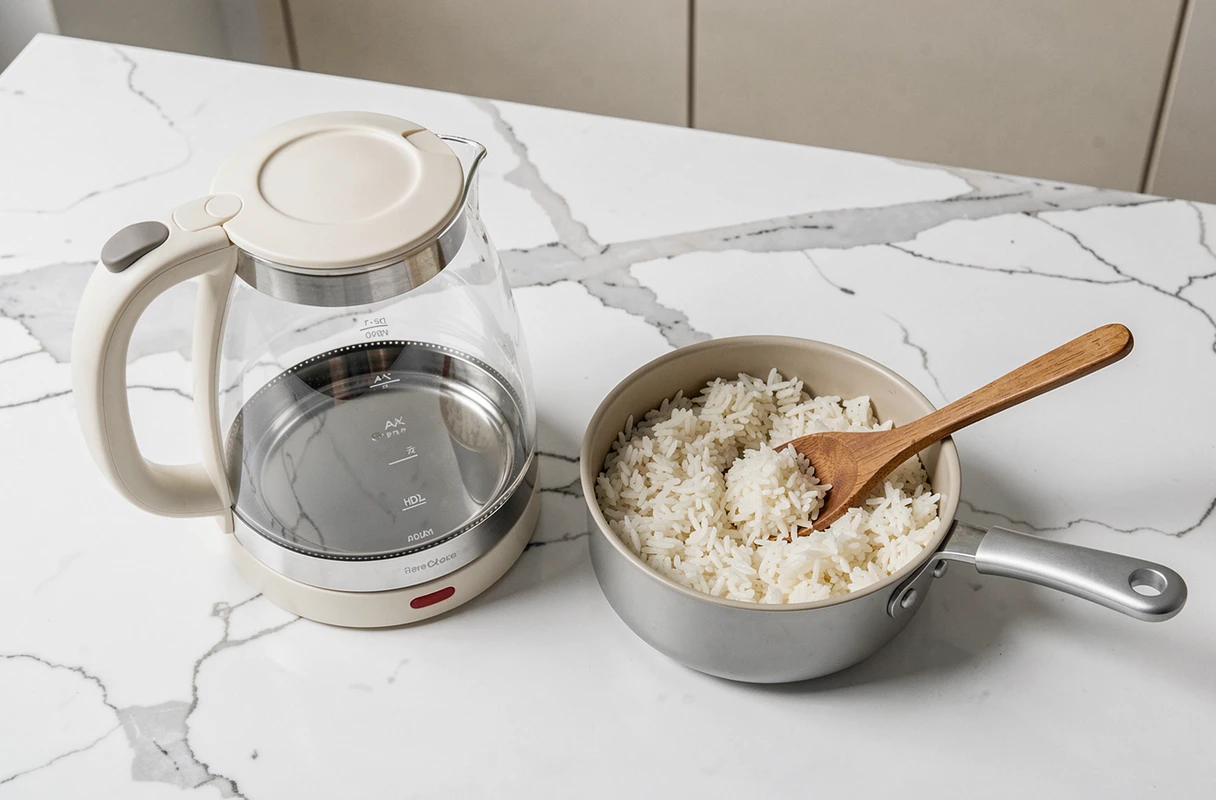
Basmati rice is the most suitable for cooking in a kettle. Its long grains release less starch, foam little, and absorb water evenly. Pour boiling water over the already rinsed rice, turn off the kettle, and let it rest with the lid closed. The resulting texture remains good, with separate grains.
Japanese rice and short grains
Short-grain Japanese rice requires more water and a longer absorption time. The foam is abundant. In a kettle, it is necessary to proceed in two short cycles rather than one long one: bring the water to a boil, turn off, wait a few minutes, then briefly restart. The result remains below what you get in a pot or rice cooker; feedback varies on this point, but the typical sticky texture is difficult to reproduce.
Brown rice and red rice
Brown rice retains its bran layer, which significantly lengthens the absorption time. A kettle does not keep the water at temperature long enough to cook these varieties properly. A common result: a grain still crunchy in the center, even after several boiling cycles. It’s better to reserve brown rice and red rice for a pot or pressure cooker.
Step-by-step method for cooking rice in an electric kettle
The technique is based on a simple principle: you do not try to cook the rice during boiling; you use the residual heat for absorption. Here are the concrete steps.
- Rinse a portion of rice (preferably basmati) under cold water until the water runs clear, to remove excess starch and limit foam
- Pour the rinsed rice into the kettle, add cold water in a ratio of about one volume of rice to one and a half volumes of water, then a pinch of salt
- Start the kettle with the lid slightly open, wait for boiling, then manually turn it off as soon as the foam starts to rise
- Close the lid and let it rest without reopening for about ten minutes, allowing the grains to absorb the residual water
- Check the texture: if the rice is still firm, restart a short cycle and let it rest again
This method works for one to two portions. Beyond that, the volume of rice and water exceeds the useful capacity of most kettles, and overflow becomes almost certain.
Kettle vs. compact rice cooker: what justifies switching to a dedicated appliance
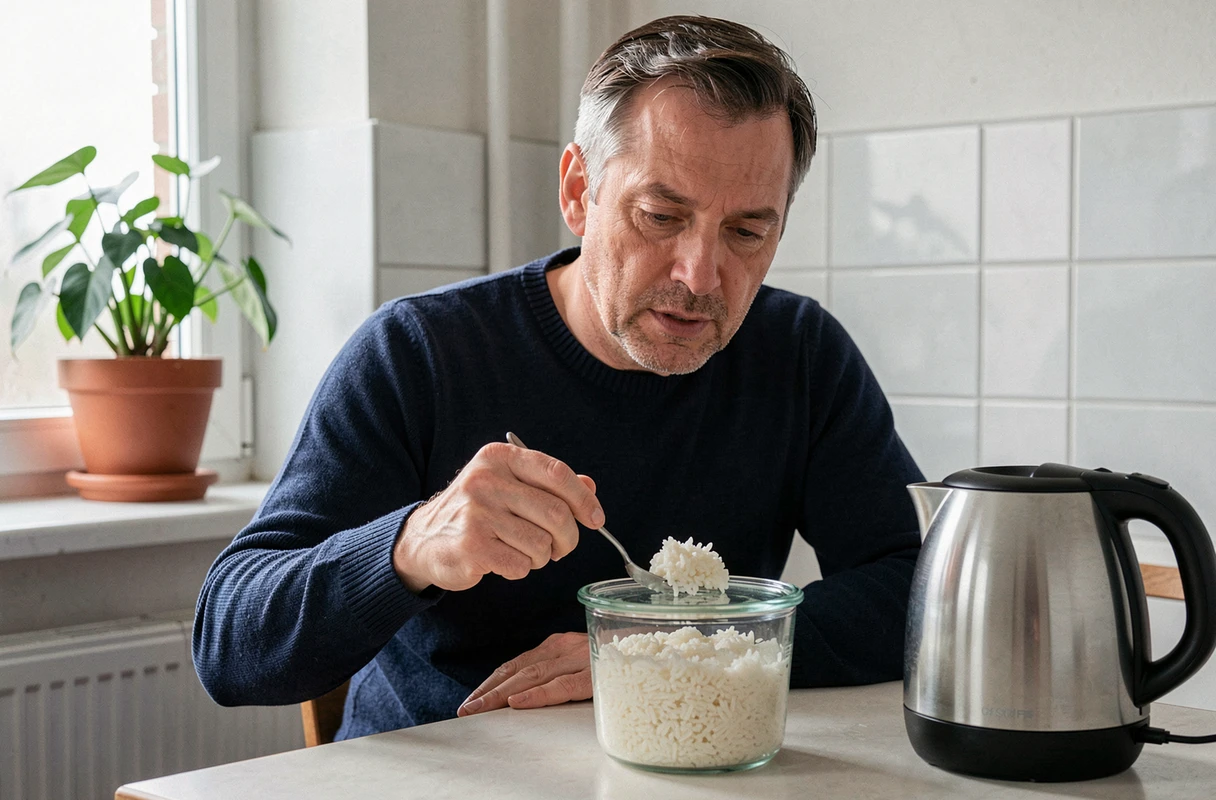
The kettle is a handy solution, but it was not designed for this task. The most noticeable difference with a compact rice cooker lies in the automatic management of temperature and cooking shut-off. A rice cooker switches to keep warm mode when the water is absorbed. A kettle, on the other hand, either shuts off abruptly or continues to heat until the safety thermostat is triggered.
Small-capacity rice cookers take up barely more space than a standard kettle. They manage the volume of foam thanks to a wider bowl and a vented lid, and produce a consistent result across all types of grains, including Japanese rice and black rice.
The kettle remains relevant when no other appliance is available and when you limit yourself to basmati rice or long grains. As soon as you cook rice several times a week, a small-capacity compact cooker represents a more sensible investment.
Maintenance and precautions after cooking rice in a kettle
The starch leaves a white residue inside the kettle, especially if the rice was not rinsed enough. This residue mixes with existing limescale and can alter the taste of the water during subsequent uses. Cleaning the kettle immediately after each rice cooking prevents buildup: a rinse with hot water followed by a wipe with a bit of white vinegar is sufficient.
Some kettles have a visible heating element at the bottom of the bowl. Rice grains can get stuck against this heating element and burn. Models with a flat bottom and hidden heating element pose fewer problems in this regard.
Cooking rice in an electric kettle does not damage the appliance if the maximum volume is respected and if it is cleaned after use. The real risk is allowing the starch foam to overflow onto the electric base, which can damage the connection. A slightly open lid and well-rinsed rice resolve this issue in the vast majority of cases.